Spain 2-0 France: World Cup Semi-Final Match Analysis, Statistics, and Highlights
In the 2026 World Cup semi-final, Spain defeated France 2-0 with goals from Mikel Oyarzabal and Pedro Porro, advancing to the final. We compiled all the details from xG data to pressing statistics, goalkeeper performances, and standout players.
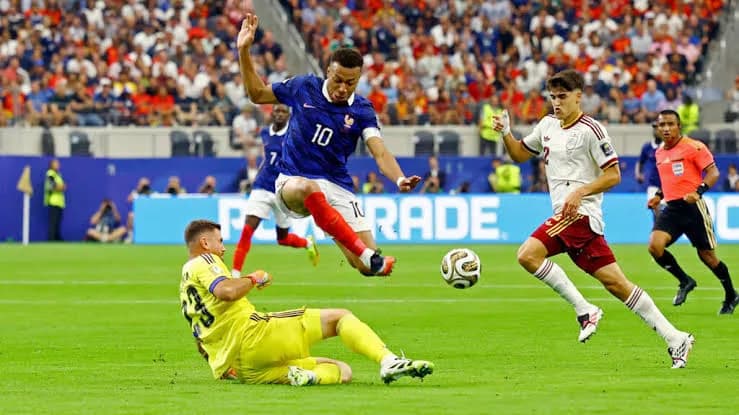
In the 2026 World Cup semi-final, Spain defeated France 2-0 in a match played on Tuesday, July 14, at Dallas Stadium (Arlington), becoming the first finalist of the tournament. The match was officiated by Ivan Barton and kicked off at 19:00.
Spain finished the first half ahead 1-0 thanks to a penalty goal from Mikel Oyarzabal in the 22nd minute, and in the second half, they doubled the lead with a goal from Pedro Porro in the 58th minute, controlling the game to the end.
Formations and Lineups
Both teams lined up in a 4-2-3-1 formation.
France: In front of goalkeeper Mike Maignan, the defense consisted of Koundé, Upamecano, Saliba, and Digne, with Tchouaméni and Rabiot in midfield, Dembélé, Olise, and Barcola in attacking midfield, and Mbappé as the striker.
Spain: In front of goalkeeper Unai Simón, the defense was formed by Porro, Cubarsí, Laporte, and Cucurella, with Rodri and Ruiz in midfield, Yamal, Olmo, and Baena in attacking midfield, and Oyarzabal as the striker.
On the France side, Désiré Doué (7.0), Rayan Cherki (6.8), and Theo Hernández (6.5) came off the bench and made an impact, while Spain's Ferran Torres (6.8) and Mikel Merino (6.7) similarly contributed.
xG Analysis: Was the Score Fair?
The most striking statistic of the match emerges from the total expected goals (xG) difference: Spain had 1.41 compared to France's 0.40. This indicates that the 2-0 scoreline truly reflects the balance of play on the field — despite the apparent closeness, Spain was clearly superior in terms of goal expectation.
While the possession difference was minimal (Spain 51% - France 49%), this gives a misleading impression of balance; Spain's ability to convert possession into dangerous moments was significantly higher.
Pressing Index and Momentum Windows
Four "momentum windows" were identified in the match where pressure remained in the same direction for at least 3 minutes:
22-36 minutes (Spain dominant): 2 shots, 0.81 xG — Oyarzabal's penalty goal came in this window
38-42 minutes (Spain dominant): 1 shot, 0.26 xG
58-70 minutes (Spain dominant): 2 shots, 0.12 xG — Porro's goal came in this window
89-100 minutes (France dominant): 1 shot, 0.10 xG
In total, 6 shots were taken across the four windows, with 2 resulting in goals — a striking ratio that shows Spain utilized the moments they applied pressure with maximum efficiency.
Pressing and Transition Statistics: The Hidden Story of the Match
Beyond the scoreline, one of the most decisive differences in the match lies in the pressing and transition data.CSNT (Clear Scoring Chances Inside the Box) Spain produced 8.0 while allowing France only 1.0 box danger — indicating that Spain maintained control in the box both offensively and defensively. In a two-way reading, Spain's ratio was 2.0x while France's was only 0.5x; this means Spain created four times the danger they allowed, while the opposite was true for France.
The difference in shot frequency was also evident: Spain took a shot every 2.55 minutes, while France took one every 2.45 minutes — although numerically close, Spain's shots produced much more accurate results. In terms of recovery intervals, Spain regained possession every 19 seconds, while France's interval extended to 23 seconds — indicating that Spain's pressing was more frequent and effective.
Significant Difference in Aerial Duels
One of the most overlooked yet striking statistics of the match emerged in aerial duels: Spain won 68% of aerial duels, while France only managed to win 32%.This difference is also reflected in extended metrics — Spain won 17 aerial duels while France only won 8. This superiority allowed Spain to remain secure against long balls defensively and gain an advantage in set pieces.
Shot and Goal Details: Area-Based Conversion
Of Spain's 10 shots, 5 came from inside the box, producing 1.19 xG; one of these shots resulted in a goal (20% conversion rate). Of the 5 shots taken from outside the box, one also found the net.
Of France's 8 shots, 3 came from inside the box but only produced 0.21 xG, with none converting into goals (0% conversion). Similarly, the 5 shots taken from outside the box also went without a goal.
In the attacking xG rankings, Oyarzabal (1 goal, 2 shots, 0.81 xG, 0.79 xGoT) topped the list. Porro (1 goal, 2 shots, 0.11 xG, 0.21 xGoT) proved his finishing quality exceeded expectations despite a low xG value. The most dangerous player for France was Mbappé (3 shots, 0.12 xG), but none of his shots resulted in goals.
Goalkeeper Performances
Unai Simón (Spain): Faced 3 shots over 90 minutes, conceded no goals (clean sheet), and made 3 saves. With a 51% passing accuracy (19 successful out of 37 attempts), he leaned more towards long balls — successfully completing 6 of 23 long pass attempts. He was the highest-rated player of the match: 7.22.
Mike Maignan (France): Conceded 2 goals (Oyarzabal 22', Porro 58') and made no saves. With an 82% passing accuracy (31 successful out of 38 attempts), he contributed to the game but ended up being the lowest-rated player: 5.97.
Standout Players
Pedro Porro (Spain) — 7.60 rating: In addition to his goal, he delivered a strong performance in interventions (77th percentile) and ball recoveries (78th percentile). In the 15-minute profile, he raised his rating to 7.6 in the last 30 minutes — he was the most in-form player during the key moments of the match.
Mikel Oyarzabal (Spain) — 7.31 rating: He ranked at the top in goal contribution (97th percentile) and xG (98th percentile). He played for 74 minutes and his performance steadily improved throughout the match.
Aurélien Tchouaméni (France) — 6.98 rating: He was the highest-rated player for France. He excelled in duels won (91st percentile) and ball recoveries (78th percentile) — he was central to the game with 76 touches over 90 minutes.
Désiré Doué (France) — 6.96 rating: Despite only being on the field for 33 minutes, he stood out with high shot (89th percentile) and accurate shot (92nd percentile) statistics — becoming one of France's most dangerous players in his short time on the pitch.
The Paradox of France: Despite Tchouaméni and Doué's high individual ratings, the team's 0-2 loss creates a striking contradiction. This indicates that France did not play poorly individually, but rather struggled with collective defensive organization during critical moments of the match (especially in Spain's momentum windows).
Set Pieces: Spain's Secret Weapon
Spain's xG value from set pieces is 0.85 — this figure is even higher than the xG from open play (0.44) and constitutes 60% of the total xG. Indeed, Oyarzabal's goal also came from a penalty. Although France had statistically more corners (7 to 1), they fell short in corner xG (0.15 to 0.00) — meaning that despite the quantity of corners, France failed to create real danger.
Discipline
France committed 11 fouls while winning 12; Spain committed 12 fouls, won 11, and earned one penalty. France received 2 yellow cards in the match (Rabiot in the 9th minute), while Spain finished with 1 yellow card (Cucurella in the 31st minute). No red cards were shown — it was a measured, controlled contest in terms of discipline.
Conclusion: Why Did Spain Win?
When all the data is compiled, Spain's victory is based not on luck, but on several concrete advantages:
xG superiority (1.41 to 0.40) — Spain created much higher quality chances
Pressing and transition efficiency — an overwhelming difference of 8.0 to 1.0 in CSNT
Aerial dominance — 68% to 32%
Set piece efficiency — 60% of total xG came from set pieces
Although France appeared to have an advantage in the number of attacks (116-109) and dangerous attacks (45-23), this advantage never translated into real danger. With this victory, Spain became the first team to advance to the final of the 2026 World Cup.