Who Is Nicolò Tresoldi? The Story and Scout Report of Club Brugge’s 21-Year-Old Striker
Who is Nicolò Tresoldi? From an Italian football family to Hannover 96 and Club Brugge, we analyse the 21-year-old striker’s journey, numbers and playing profile.
Who Is Nicolò Tresoldi?
Born in Italy, raised partly in Gubbio and developed as a footballer in Germany, Nicolò Tresoldi has taken an unconventional route to becoming one of Club Brugge’s most productive young forwards.
He grew up in a football family, spent part of his childhood balancing football with tennis, had trials with several major Italian clubs without finding a permanent home, and then moved to Germany with his family at the age of 13.
That move ultimately changed the direction of his career.
Tresoldi spent close to eight years in the Hannover 96 system, progressed from academy football to the first team and later earned a move to Club Brugge, where he added Belgian top-flight and Champions League experience to his development.
Now 21, his statistical profile points to one defining strength:
Tresoldi consistently gets into scoring positions.
He scored 19 league goals from 17.3 xG in 2025/26 and also produced 3.52 xG in 550 Champions League minutes. He has started 2026/27 with 2 goals from 2.71 xG in just 168 league minutes.
A Footballing Father and an Argentine Connection
Tresoldi was born on 20 August 2004 in Cagliari, Italy.
His father, Emanuele Tresoldi, was a professional left-back who played for a number of Italian clubs, including Atalanta, and was part of Italy’s squad that won the 1994 UEFA European Under-21 Championship.
His mother, Barbara Caffi, was born in Argentina and comes from an Italian family background.
That gives Tresoldi a multicultural story connecting Italy, Germany and Argentina.
He is also multilingual, speaking Italian, German, English and Spanish.
His childhood was spent in the Umbrian town of Gubbio, where the family had settled during his father’s playing career.
Football Was Not His Only Option
Tresoldi did not grow up focused exclusively on football.
He also showed talent in tennis and spent significant time playing the sport as a youngster. He even trained with Flavio Cobolli, who would later pursue a professional tennis career.
Around the age of 12 or 13, however, Tresoldi made his choice.
Football — and specifically the feeling of scoring goals — won.
It is an interesting detail when viewed through the player he has since become.
His current attacking profile remains centred on exactly that instinct: finding the goal, attacking the box and repeatedly placing himself in finishing situations.
Rejected in Italy, Developed in Germany
Tresoldi’s early path was not straightforward.
He had trials with clubs including Juventus, AC Milan, Fiorentina, Roma, Bologna, Atalanta and Sampdoria, but none resulted in a permanent move.
His decisive development phase would instead come in Germany.
In 2017, his family relocated after his mother began working at Hannover Airport. Tresoldi was 13.
He soon entered the Hannover 96 academy and began the process that would eventually take him to professional football.
Eight Years of Development at Hannover 96
Tresoldi progressed through Hannover’s youth system at U17 and U19 level before moving into senior football.
He signed his first professional contract in January 2022 and made his 2. Bundesliga debut against Kaiserslautern on 15 July of the same year.
His role grew over the following seasons.
The Hannover years helped shape more than his finishing. His movement in behind, penalty-box positioning, physical work and off-ball intensity became important parts of his game.
After almost eight years in the club’s system, his development was rewarded with a move to Club Brugge in the summer of 2025.
Club Brugge Move Took Him to Another Level
Tresoldi joined Club Brugge from Hannover 96 in 2025.
According to the information provided, the fee was reported in the region of €7 million to €7.5 million, with bonuses potentially taking the package close to €10 million.
His contract runs until 2029.
For Tresoldi, the transfer represented a significant step:
first-division football and the Champions League.
His first full season suggests he was able to handle that jump.
2025/26: 19 Goals From 17.3 xG
Tresoldi’s first full Pro League campaign produced strong numbers.
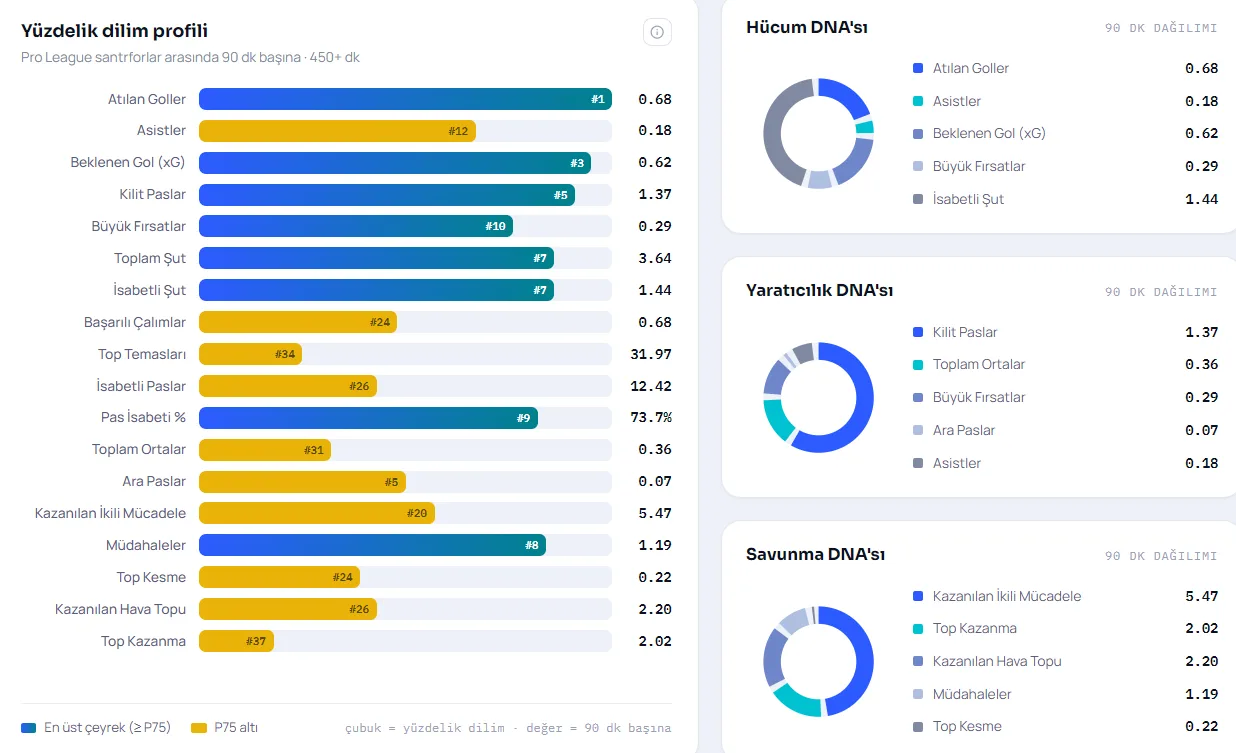
Among qualifying Pro League strikers, Tresoldi ranked first for goals per 90, third for xG per 90 and seventh for shots per 90.
His 19 goals came from 17.3 xG.
That difference matters because his output was not detached from the quality of the chances he received.
Rather than relying on extreme finishing overperformance, the more sustainable part of his profile appears to be his ability to keep arriving in good scoring positions.
His Biggest Strength: Getting Chances
Goals are the headline statistic for any striker, but there is a more fundamental question when evaluating a young forward:
Can he repeatedly get into positions from which goals are likely?
For Tresoldi, the answer is encouraging.
He produced 0.62 xG per 90 in the 2025/26 Pro League while taking 3.64 shots per 90.
That works out at roughly 0.17 xG per shot.
It suggests his shot volume was not built solely on low-probability attempts.
Tresoldi’s value comes from repeatedly finding the areas where meaningful finishing opportunities exist.
Champions League Test: The Core Profile Survived
Tresoldi also played 550 minutes across 10 Champions League appearances in 2025/26.
He recorded:
3 goals
2 assists
3.52 xG
0.49 goals per 90
0.58 xG per 90
2.95 shots per 90
1.31 shots on target per 90
There was an expected drop in volume against stronger opposition.
His shots fell from 3.64 to 2.95 per 90, while his goals dropped from 0.68 to 0.49.
The most interesting number, however, is xG.
0.62 per 90 in the Pro League became 0.58 in the Champions League.
Despite the increase in opposition quality, the decline in his expected-goal production was relatively small.
That is an encouraging signal because it suggests Tresoldi’s ability to reach valuable scoring positions did not disappear when the level increased.
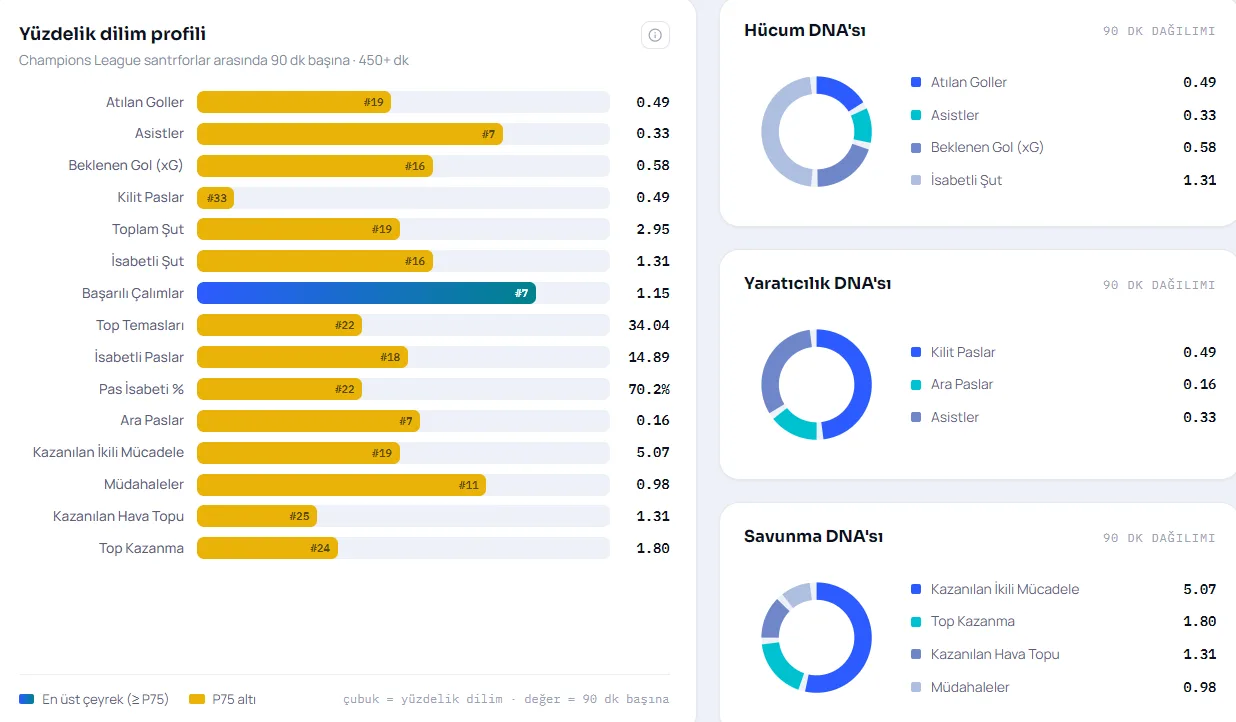
The clearest takeaway is that while his overall attacking volume dropped in Europe, his chance quality remained relatively stable.
His successful dribbles also increased from 0.68 to 1.15 per 90, although the smaller Champions League sample and different match contexts mean that should not be treated as proof of a permanent stylistic shift.
More Than Just a Finisher
Tresoldi is not a playmaking striker, but his domestic creative numbers are useful.
He averaged 1.37 key passes per 90 in the 2025/26 Pro League, ranking fifth among qualifying strikers.
He also registered five assists.
That suggests he can contribute to attacks before the final shot rather than operating purely as a penalty-box finisher.
There is, however, a level-dependent difference.
His key-pass output dropped to 0.49 per 90 in the Champions League, suggesting his creative influence became more limited against stronger opposition.
Passing Gives Him Another Layer
Tresoldi completed 73.7% of his passes in the 2025/26 Pro League, ranking ninth among qualifying strikers.
That alone does not make him an elite link player, but it is a useful number for a forward whose primary value comes inside and around the box.
Early in 2026/27, his pass completion has risen to 79.1%.
The sample is only 168 minutes, so it would be premature to describe that as a lasting improvement, but it is a positive early signal.
Physical, But Not a Traditional Target Man
Tresoldi stands 1.83 metres tall and weighs 77 kilograms.
He can compete physically, but the data does not describe him as a dominant aerial striker.
In the 2025/26 Pro League, he averaged:
2.20 aerial duels won per 90
which ranked 26th among qualifying strikers.
His overall duels won figure was 5.47 per 90.
So Tresoldi is better described as a forward who uses his physical qualities through movement, contact, intensity and repeated battles with defenders, rather than as a classic target man built around aerial dominance.
Active Without the Ball
His defensive work is another useful component of the profile.
Tresoldi averaged 1.19 tackles per 90 in the 2025/26 league season, eighth among qualifying strikers.
He maintained 0.98 tackles per 90 in the Champions League.
Those numbers support the idea that he does not disengage when possession is lost.
For teams that expect their centre-forward to work in the first defensive line, that gives him additional tactical value.
2026/27 Has Started Strongly
The new season sample remains extremely small, but the opening numbers are notable.
Across two Pro League appearances and 168 minutes, Tresoldi has produced:
2 goals
2.71 xG
4.82 shots per 90
2.14 shots on target per 90
1.61 key passes per 90
7.12 average rating
His 1.45 xG per 90 currently ranks first among the qualifying Pro League striker sample.
But the important methodological point is the size of the sample.
Two matches are not enough to establish a new performance level.
The more useful early takeaway is this:
Tresoldi has generated 2.71 xG in only 168 minutes.
That is arguably more interesting than the two goals themselves.
It suggests the underlying characteristic that powered his previous season — repeatedly getting high-value chances — remains present.
What Type of Striker Is Nicolò Tresoldi?
The current data points towards a fairly clear profile.
Tresoldi is a striker who:
repeatedly attacks the penalty area,
generates strong xG numbers,
maintains healthy shot volume,
threatens the space behind defences,
works without the ball,
can contribute to combinations,
offers some chance creation,
and relies more on movement than aerial dominance.
What makes him interesting is not simply the fact that he scored 19 league goals.
It is how often he puts himself in situations from which goals can reasonably be expected.
Areas for Development
Tresoldi is still an unfinished striker.
Creative impact at Champions League level
His 1.37 key passes per 90 in the Pro League fell to 0.49 in Europe.
Becoming more influential in combination play against stronger opponents would make him a more complete forward.
Aerial game
He competes physically but is not dominant in the air.
Improvement there would give him another solution against deep or physically strong defensive blocks.
Repeating his output
His 2,500 Pro League minutes in 2025/26 give us a meaningful sample.
The next question is whether he can reproduce that level for a second consecutive season as expectations rise and opponents gain more information about his game.
The early 2026/27 numbers are promising, but two games cannot answer that yet.
A Career Shaped by Three Countries
Tresoldi’s story is difficult to reduce to statistics alone.
He was born in Italy.
He grew up as the son of a professional footballer and an Argentine-born mother.
Several major Italian clubs looked at him as a youngster, but none became his long-term development home.
At 13, he moved to Germany.
Hannover 96 developed him from academy player to professional over almost eight years.
At youth international level he chose Germany and went on to reach the 2025 European Under-21 Championship final.
Then came Club Brugge and Champions League football.
At 21, he is now entering one of the most important development periods of his career.
And the StatsLook numbers point towards the quality that makes his profile particularly interesting:
Tresoldi does not merely score goals. He repeatedly gets himself into positions where goals should happen.
If he can maintain that trait against stronger opposition while improving his link play and overall completeness, his next career step may eventually become much bigger than the one that took him from Hannover to Brugge.