How Manchester City went 5-for-5 — and what Liverpool can test at Anfield
Manchester City arrive at Anfield with a perfect Premier League record, but their early-season profile is more interesting than the results alone. StatsLook data shows a team generating higher-value chances from fewer shots, while Liverpool bring greater attacking volume into Sunday’s meeting.

Manchester City have spent the international break dealing with headlines far removed from the pitch, but Enzo Maresca’s message ahead of Sunday’s trip to Liverpool has been simple: the players are focused on football.
Speaking after the Premier League verdict concerning City’s financial-rule breaches, Maresca said the feeling inside the squad remained “fantastic” and insisted his players were concentrating on what they could control.
So far, that focus has produced the clearest possible result: five Premier League matches, five wins.
The more relevant question before the Liverpool vs Manchester City match, however, is not simply whether City can extend that run. It is how they have built it — and whether the same attacking profile can survive a very different test at Anfield.
City are creating more value from fewer shots

StatsLook data from the opening five league matches shows a clear contrast between the two teams.
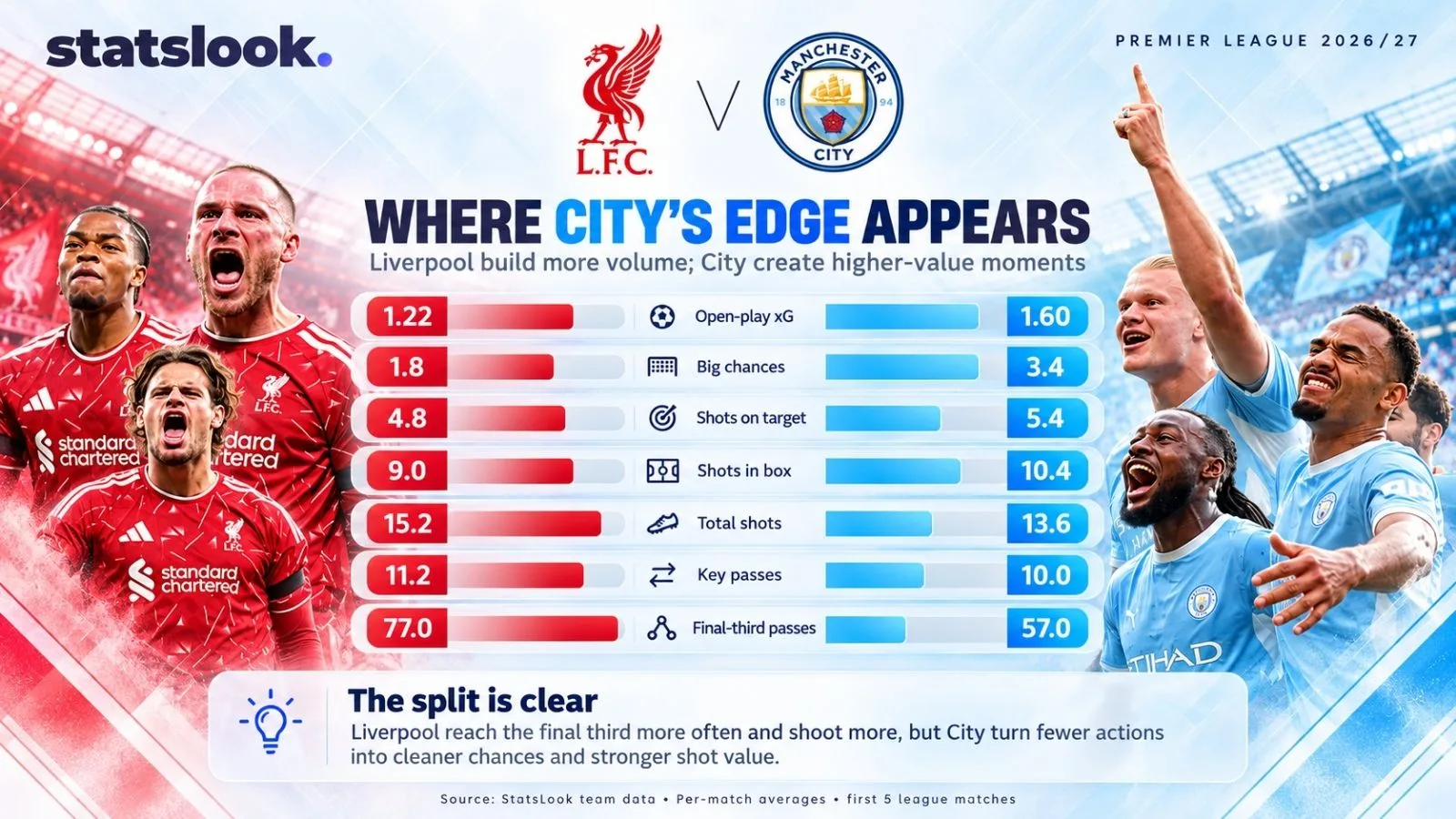
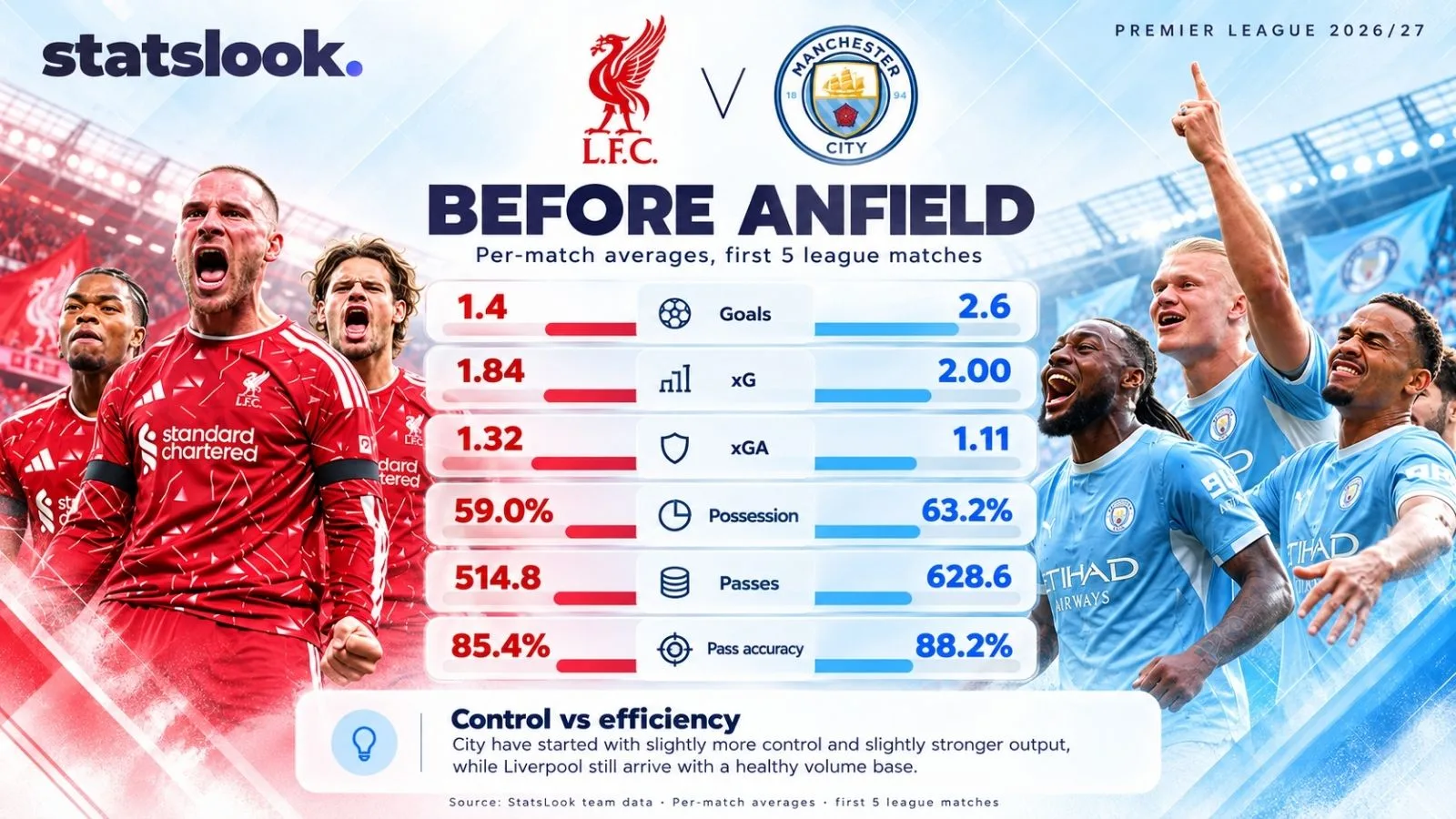
Manchester City are averaging 2.00 xG per match, compared with 1.84 for Liverpool.
Yet Liverpool are taking more shots.
Liverpool average 15.2 shots per game, while City sit at 13.6.
That relationship matters more than the raw shot totals. City are producing greater expected-goal value from a lower volume of attempts, suggesting that the difference so far has been shaped by where and how those chances are being created.
The big-chance numbers reinforce that point.
City are generating 3.4 big chances per match. Liverpool are at 1.8.
City also average 10.4 shots from inside the box, compared with Liverpool’s 9.0.
Across this small early-season sample, Maresca’s side have not needed the largest shot volume to create the stronger chance profile.
Liverpool bring more attacking volume into the final third
Liverpool’s attacking profile tells a different story.
They average 77 final-third passes per match, considerably more than City’s 57.
Liverpool also produce 11.2 key passes, compared with 10.0 for City, and take more total shots.
That points to a side reaching advanced areas frequently and sustaining a significant amount of attacking activity.
The difference is what happens after those actions.
Liverpool are currently producing more volume, but City are turning fewer shots into more xG and almost twice as many big chances.
That creates the central question around Sunday’s game:
Can Liverpool’s attacking volume overwhelm City, or will City’s ability to create higher-value chances prove more decisive?
City’s perfect start is not only about finishing
Manchester City are scoring 2.60 goals per match from 2.00 xG.
That means their finishing has run above expected output during the opening five games.
With such a small sample, it would be too early to describe that gap as a sustainable finishing advantage.
But the underlying numbers also make it difficult to dismiss City’s start as a short run of clinical finishing.
They are averaging:
2.00 xG
2.01 xGoT
1.60 open-play xG
3.4 big chances
Liverpool, by comparison, have produced 1.84 xG, 1.66 xGoT and 1.22 open-play xG.
The margins are not enormous, but City’s advantage in open-play chance value and big-chance creation gives their five-win start a stronger underlying foundation than the scorelines alone suggest.
Possession is leading the two teams to different outcomes
City have also controlled more of the ball.
Maresca’s side average 63.2% possession, compared with Liverpool’s 59.0%.
Their passing volume is substantially higher too: 628.6 passes per match against Liverpool’s 514.8.
City have completed those passes at 88.2%, while Liverpool are at 85.4%.
But possession itself is not the important part of the comparison.
Liverpool are reaching the final third more often and taking more shots. City are using their possession to generate fewer attempts but higher-value opportunities.
Two teams can therefore control territory in different ways.
Liverpool’s early-season profile has been built around volume. City’s has been more closely associated with chance quality and efficiency.
Anfield will test whether City’s early profile travels
Five matches remain a limited sample, and early-season numbers should not be treated as a settled picture of either team.
That is precisely what makes Anfield important.
Liverpool will present City with a side that generates more shots, plays more passes into the final third and carries a larger attacking volume than Maresca’s team has produced itself.
City, meanwhile, arrive with the stronger xG output, more big chances and a perfect league record.
If the structure behind their 5-for-5 start holds up at Anfield, the evidence supporting City’s early-season performance becomes stronger.
If Liverpool can turn their territorial and attacking volume into higher-quality opportunities, Sunday could expose the limits of City’s current efficiency advantage.
The Liverpool vs Manchester City match centre brings the fixture data together in one place.
Before the official line-ups are announced, users can also build their own squads, adjust the tactical setup and explore possible scenarios through StatsLook Match Simulation. Once the official XIs are confirmed, the system simulation can be evaluated with the actual starting line-ups.