Lille 2-3 Real Betis: How Betis Overturned the Match Before the Red Card
Real Betis came from behind twice to beat Lille 3-2. Bartra’s brace, Betis’ 19 shots and a decisive 31-60 minute spell explain why the comeback was already complete before the red card.
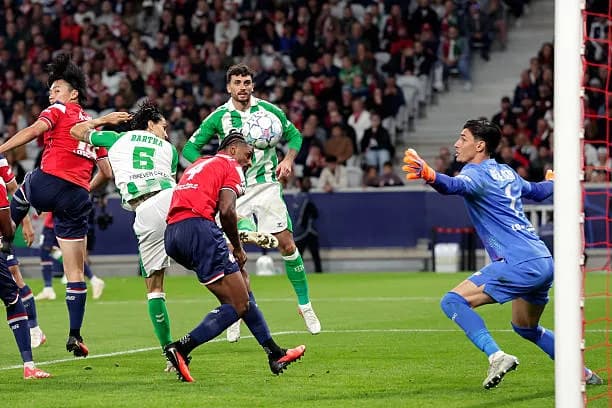
Real Betis’ 3-2 win away to Lille is easy to misread if the 56th-minute red card becomes the main explanation.
By the time Ethan Mbappé was sent off, Betis were already 3-2 ahead.
Lille had taken the lead through Ayase Ueda in the 12th minute. Marc Bartra equalised in the 33rd. Alexsandro restored Lille’s advantage three minutes later. Bartra made it 2-2 in the 49th, before Troy Parrott completed the turnaround in the 53rd.
The dismissal came three minutes later.
So the numerical advantage did not create the comeback.
Betis had already overturned the game. The red card merely made Lille’s route back into it more difficult.
That distinction changes the entire tactical reading.
The Comeback Started Before Half-Time
Lille went into the break 2-1 ahead.
But the final 15 minutes of the first half already showed that the direction of the game was changing.
Between minutes 31 and 45, Betis produced:
6 shots
0.78 xG
Lille managed just one shot and 0.08 xG in the same period.
Bartra’s first equaliser came during that spell.
Alexsandro’s 36th-minute goal put Lille back in front, but the scoreline did not fully reflect the flow of the match.
Betis had already started to push the game towards Lille’s penalty area.
That continued immediately after the restart.
Between minutes 46 and 60, Betis added:
3 shots
0.45 xG
with Bartra and Parrott scoring.
Across the 31-60 minute period as a whole, Betis generated:
9 shots and 1.23 xG.
Lille’s attacking output over the same half-hour was almost completely shut down.
The real turning point, then, was not the dismissal.
It was Betis increasing their attacking volume from the 31st minute onwards.
Similar Final-Third Access, Completely Different End Product
One of the most revealing numbers in the match concerns final-third passing.
Lille completed:
46 final-third passes
Real Betis:
50 final-third passes
The difference was only four.
But the key-pass numbers were:
Lille: 5
Real Betis: 18
And the shot totals:
Lille: 6
Real Betis: 19.
That is a major tactical distinction.
Betis did not dominate simply because they entered advanced areas much more frequently.
The two teams reached the final third a broadly similar number of times.
Betis produced far more from those entries.
Lille’s problem was not only progressing the ball.
It was turning that progression into genuine final actions.
Betis converted similar territorial access into a much higher volume of shots and chances.
That was one of the defining differences in the game.
Lille’s 2-1 Half-Time Lead Hid a Lack of Attacking Continuity
Lille’s half-time lead makes their attacking performance look stronger than it actually was over the full 90 minutes.
They finished with:
6 shots
2 shots on target
0.96 xG
1 big chance
Most strikingly, both of their shots on target resulted in goals.
Álvaro Valles finished the match without making a save.
That tells us Lille were extremely efficient when they did create a good opportunity.
But they did not create enough of them.
Four of their six shots came from inside the penalty area and generated 0.90 xG.
So the shot quality itself was not particularly poor.
The issue was repeatability.
Lille could hurt Betis when they reached the right zones.
They simply could not get there often enough.
Lille Failed to Attempt a Shot Between Minutes 46 and 75
This may be the sharpest number in the entire match.
Lille produced:
46-60: 0 shots
61-75: 0 shots
That means they went the first 30 minutes of the second half without a single attempt.
Betis turned a 2-1 deficit into a 3-2 lead during that spell.
So the comeback cannot be explained only by Bartra’s unusual goalscoring contribution.
Betis were scoring while Lille were not even generating attempts.
Crucially, that attacking collapse began before the red card.
Lille did not create a shot between the restart and Mbappé’s dismissal in the 56th minute either.
That shows Betis had already taken control of the rhythm before gaining the numerical advantage.
Ayase Ueda Scored, But Lille Could Not Keep Him Involved
Ayase Ueda put Lille ahead in the 12th minute.
The chance was worth 0.49 xG and he converted it with a header.
But across 77 minutes, his overall involvement was limited:
14 touches
8 passes
1 shot
1 goal.
He did his job when the chance arrived.
The bigger problem was that Lille never managed to consistently bring him back into the game.
His first shot was also his last.
That points to a structural issue rather than a finishing issue.
Lille’s striker did not waste repeated opportunities.
Lille simply failed to create repeated opportunities for him.
Parrott Had a Very Different Centre-Forward Profile
At the other end, Troy Parrott was much more involved.
He finished with:
34 touches
4 shots
0.69 xG
1 goal
1 key pass.
The contrast with Ueda reflects the wider difference between the two attacks.
Ueda finished the opportunity he received but was largely disconnected afterwards.
Parrott remained involved in finishing actions throughout the match.
His 53rd-minute goal, which completed the comeback, came from a Betis attack that continued to feed its striker rather than allowing him to drift out of the game.
Marc Bartra: Two Goals, Two Equalisers
The outstanding individual story belonged to Marc Bartra.
The centre-back scored twice in a match where Betis twice fell behind.
33rd minute: 1-1
49th minute: 2-2
Both goals were headers.
His attacking numbers were remarkable:
2 shots
0.39 xG
2 goals
1.41 xGoT
He finished with an 8.55 rating.
The important point is not simply that a defender scored twice.
His two goals repeatedly reset the game state for Betis.
And the gap between 0.39 xG and 1.41 xGoT also suggests significant shot execution once the headers were directed on target.
Bartra also contributed defensively with seven clearances, won five of six duels and claimed four aerial duels.
This was not a centre-back producing an accidental brace.
It was a two-way performance that directly altered the match twice.
Four of the First Five Goals Came From Headers
The aerial nature of the scoring was another unusual feature.
The first four goals came from headers:
Ueda.
Bartra.
Alexsandro.
Bartra.
Parrott then scored the fifth with his left foot.
But it would still be wrong to reduce the match to a set-piece story.
Betis generated:
1.28 open-play xG
0.45 set-piece xG
0.02 transition xG
from their 1.75 total xG.
So while Bartra’s aerial finishing was decisive, Betis’ wider attacking superiority was not built solely on dead-ball situations.
The majority of their threat still came from open play.
Betis’ Creativity Was Distributed Across the Team
One of the strongest aspects of Betis’ attacking structure was how widely the creative load was shared.
Pablo Fornals produced:
4 key passes
Isco:
3
Antony:
3
Rodrigo Riquelme:
2
Héctor Bellerín:
2.
That matters.
Betis’ 18 key passes were not the product of one playmaker having an extraordinary night.
The creative contribution came from central midfield, the No.10 zone, wide players and the full-back.
That makes the attack more difficult to shut down.
Stopping Isco does not automatically stop Betis.
Fornals can take over creation.
Antony can produce from the right.
Bellerín can add from deeper or wider positions.
Riquelme provides another route.
The creativity was distributed rather than concentrated.
Pablo Fornals Was One of the Hidden Controllers
Bartra took the headlines, but Pablo Fornals’ 90 minutes were central to understanding how Betis controlled possession.
He attempted 75 passes, completed 66 and produced four key passes.
His rating was 7.81.
The four key passes are particularly important because Fornals started as part of the double pivot in the 4-2-3-1.
That meant Betis were not dependent on Isco as the only central creator.
They could create from deeper midfield positions as well.
For opponents, that complicates the defensive plan.
Closing Isco’s space may not be enough if Fornals can still progress the ball and create shots from behind him.
Antony: High Shot Volume, Low Shot Quality
Antony’s performance produces a different type of scouting note.
Across 90 minutes he recorded:
6 shots
0.20 xG
1 shot on target
0.04 xGoT
3 key passes.
Six shots was the highest total in the team.
But those attempts were worth only 0.20 xG combined.
That makes his creative contribution arguably more valuable than his shooting contribution.
Three key passes represented real attacking value.
The shot selection, by contrast, was generally low-value.
That raises an interesting tactical question:
Would Betis become even more efficient if Antony converted some of those low-probability shots into additional creative actions?
On this evidence, it is worth monitoring.
Betis’ Real Advantage Was Not Possession — It Was Attack Speed
Betis had 55% possession.
Lille had 45%.
A 10-point gap does not describe a dominant possession performance.
The more revealing number comes from shot frequency while in possession.
Lille needed roughly:
3.41 minutes of possession per shot
Betis:
1.25 minutes per shot.
That is a much clearer explanation of the attacking difference.
Betis did not simply have much more of the ball.
They used their possession much more aggressively.
Again, this connects with the final-third passing numbers.
The two teams reached advanced zones at similar rates.
Betis turned those moments into shots much faster.
Pressing Was Not the Main Explanation
Both teams recorded the same ball-recovery interval:
22 seconds.
That is important because it would be tempting to explain the 19-6 shot difference by saying Betis simply pressed much harder.
The numbers do not support that conclusion.
The bigger difference came after possession was won or established.
Betis created far more threat from the ball they had.
Their advantage was not primarily about winning possession earlier.
It was about developing attacks better.
Betis Did Not Overwhelm Lille After the Red Card
Mbappé’s dismissal naturally changed the conditions of the match.
But Betis did not spend the final half-hour creating chance after chance against ten men.
Between minutes 61 and 75:
2 shots
0.06 xG
Between minutes 76 and 90+:
2 shots
0.05 xG
That is only 0.11 xG over the final 30 minutes.
This is another reason why the red card should not be treated as the main explanation for the result.
Betis had already completed the comeback.
Once ahead and playing against ten men, they became much more conservative.
They managed the lead rather than aggressively expanding it.
Lille even created one late chance worth 0.44 xG.
So the accurate reading is:
Betis overturned the match at 11v11, then managed the advantage after the dismissal.
Lille Still Found One Late Chance, But No Sustained Pressure
Lille’s only shot in the 76-90+ period was worth 0.44 xG.
That shows they were not completely dead after going down to ten men.
But one high-quality chance is not the same as sustained attacking pressure.
Lille produced only one shot across the entire second half.
That was nowhere near enough to consistently threaten the scoreline.
The red card made their task harder.
But the loss of attacking continuity had begun well before it.
Lille’s Defensive Volume Shows How the Game Shifted
Lille recorded:
17 tackles
Betis:
7
Lille also blocked six shots compared with Betis’ two.
That does not automatically mean Lille defended better.
In context, it tells us how often they were forced to react.
As Betis’ attacking volume increased, Lille became the team making defensive actions rather than dictating the game.
That shift was most obvious between minutes 31 and 60.
What Should Opponents Test Against Real Betis?
One match cannot define Betis’ entire season profile.
But several useful scouting questions emerge.
First, stopping Isco may not be enough.
Fornals produced four key passes, Antony three, Riquelme two and Bellerín two.
Second, Bartra must be treated as a genuine set-piece and aerial threat.
He scored two headers and produced 1.41 xGoT.
Third, Parrott stayed connected to the attack.
Four shots and 0.69 xG show a striker repeatedly reaching finishing situations.
Fourth, Antony’s shot selection may offer opponents a trade-off.
Allowing some of his low-value shots may be preferable to giving him space to create for others.
Fifth, Betis’ attacking aggression clearly dropped once they went ahead.
In this match, they were much more aggressive when chasing the game than when protecting the lead.
Lille’s Main Problem Was Attacking Continuity
Lille scored twice.
They led twice.
They went into half-time 2-1 ahead.
Yet their total attacking output was:
6 shots
5 key passes
1 big chance
0.96 xG.
That makes it difficult to explain the defeat purely through the red card or defensive errors.
The more fundamental problem was continuity.
They could not keep Ueda involved.
They failed to attempt a shot between minutes 46 and 75.
They completed 46 final-third passes but generated only five key passes.
And once Betis increased the pressure, Lille lost almost all counter-attacking threat.
Conclusion: Betis Won the Match Before the Red Card
The simplest version of the story would be:
“Lille were ahead, went down to ten men and Betis came back.”
The sequence of events says otherwise.
When the red card arrived, Betis were already 3-2 ahead.
The comeback began with the 0.78 xG surge between minutes 31 and 45.
Bartra’s second equaliser arrived in the 49th minute.
Parrott completed the turnaround in the 53rd.
Betis played only four more final-third passes than Lille but produced:
13 more key passes,
13 more shots,
2 more big chances.
That is the real tactical story.
The two teams reached similar advanced zones, but Betis extracted dramatically more value from those possessions.
Bartra twice reset the score.
Fornals, Isco and Antony shared the creative burden.
Parrott remained involved as the final target.
Lille, meanwhile, could not turn first-half finishing efficiency into sustained second-half attacking output.
So the 3-2 result was not primarily the product of the red card.
It was the result of one team producing far more from the same areas of the pitch.