Lille vs Galatasaray: The Second-Half Warning Signs
Lille and Galatasaray are chasing their first Champions League points. StatsLook examines their second-half setbacks, xG figures and the key tactical questions.
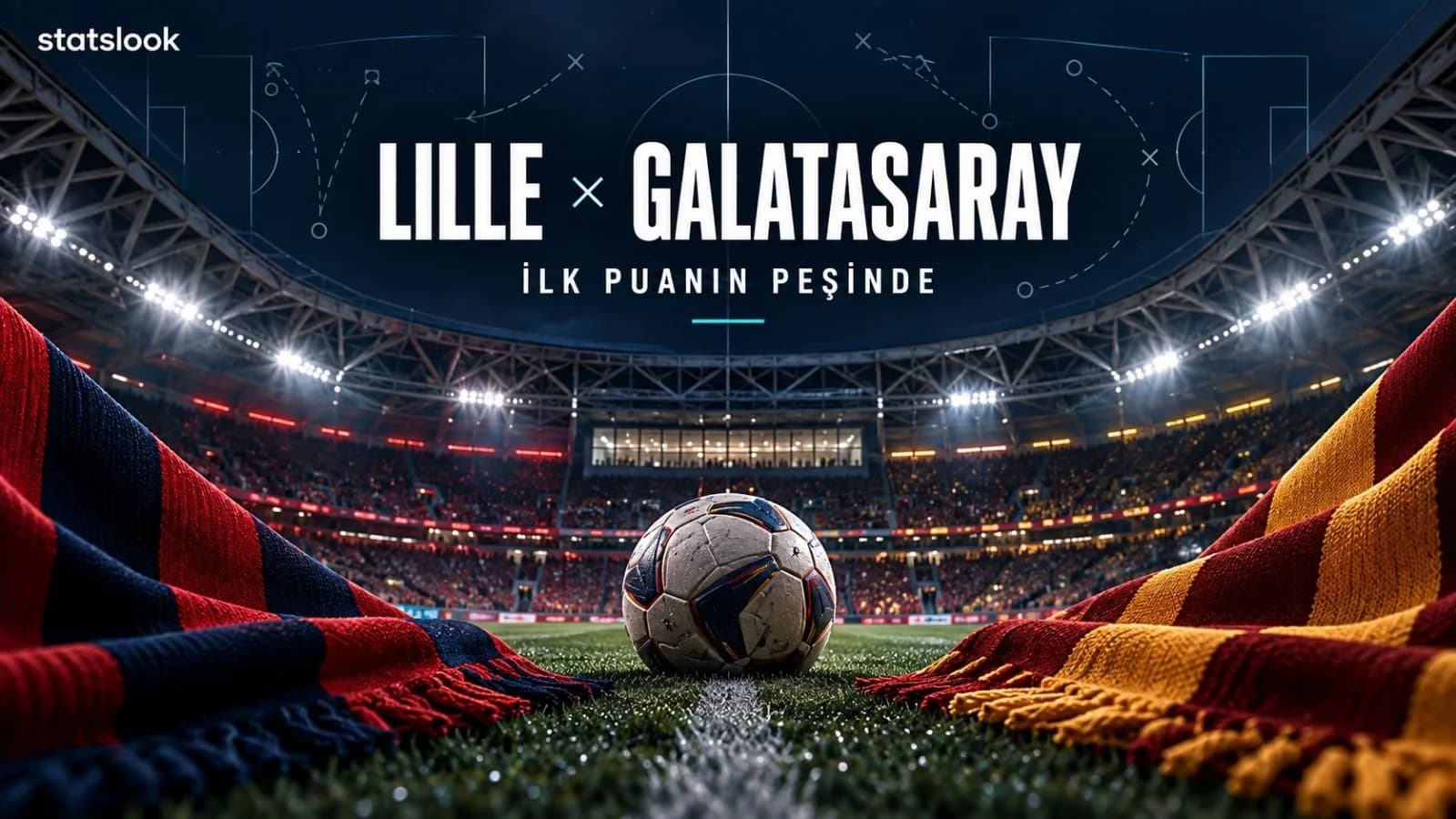
Galatasaray travel to Lille in search of their first Champions League points of the season. The French side are also without a point after two matches. But this meeting is about more than the early standings: StatsLook’s match reports highlight a warning shared by both clubs — conceding several goals in short spells after half-time.
Lille host Galatasaray at Stade Pierre-Mauroy on Wednesday, 21 October 2026. Kick-off is at 18:45 local time in France, 19:45 in Türkiye and 16:45 UTC. The league-phase Matchday 3 fixture will be shown live on TRT 1 in Türkiye.
Both sides are looking for their first points
Galatasaray followed a 3–1 defeat away to Sporting with a 4–1 home loss against Barcelona. Lille lost 3–2 at home to Real Betis before going down 3–0 at Arsenal. Those results raise the stakes, although a third-round league-phase fixture should not be presented as a mathematical elimination match.
The more useful question is how those defeats developed. Identical points totals do not mean identical strengths or weaknesses.
Galatasaray’s two defeats tell different stories
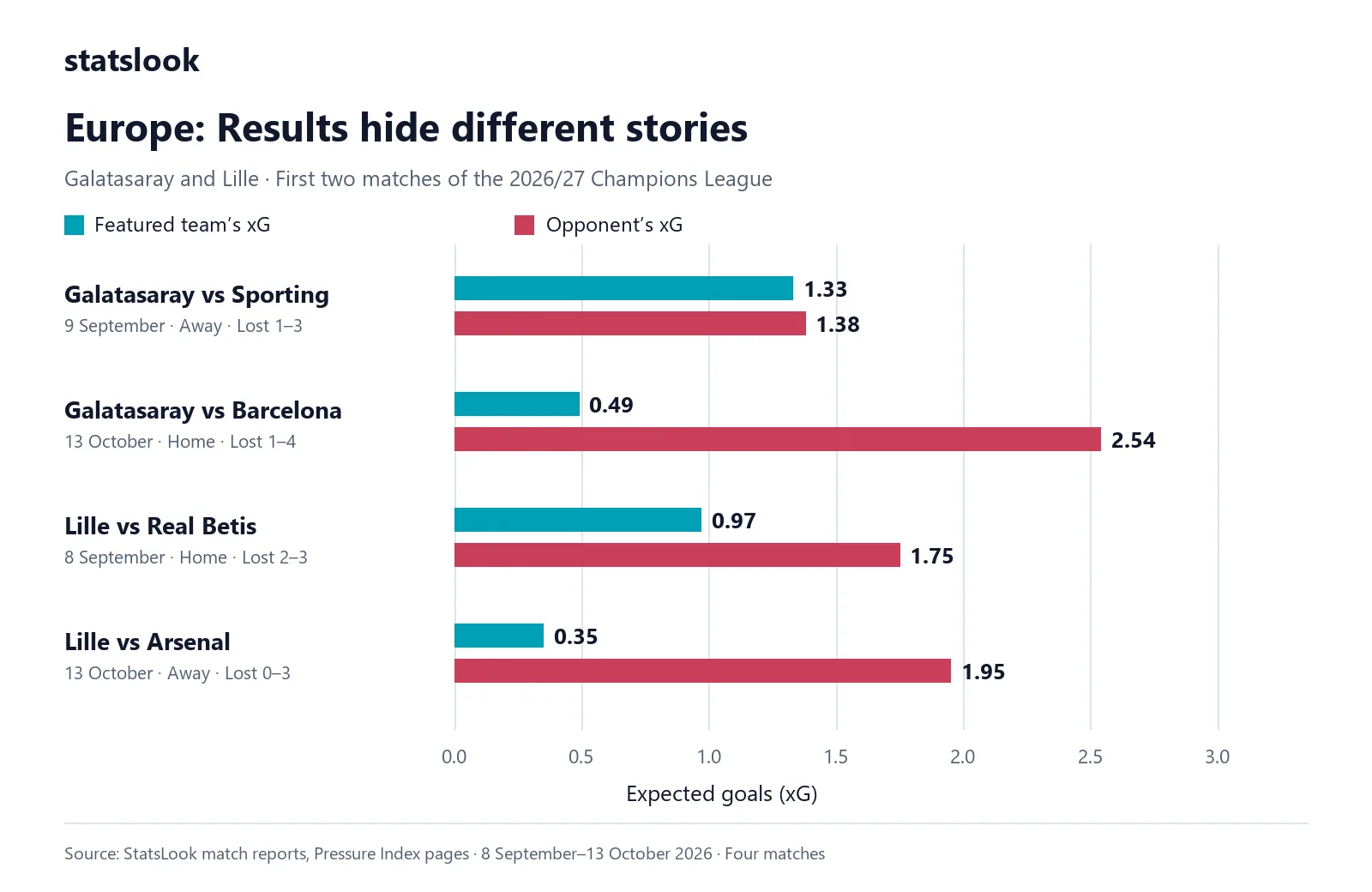
Against Sporting, Galatasaray generated 1.33 expected goals to their opponents’ 1.38. They had 62% possession and attempted 10 shots. Yet, after going into the break level at 1–1, they conceded in the 57th and 63rd minutes as the match swung Sporting’s way.
The Barcelona game exposed a more substantial problem with chance creation. Galatasaray managed five shots and 0.49 xG, while Barcelona produced 22 shots worth 2.54 xG. Despite taking the lead and reaching half-time at 1–1, the hosts conceded again in the 50th, 53rd and 65th minutes.
That distinction matters ahead of Lille. Galatasaray cannot judge their attacking performance simply by how much of the ball they have. Possession needs to become penalty-area entries and good shooting opportunities, while the connection between defence and midfield must hold when the opposition apply pressure.
Galatasaray’s xG balance against Sporting differed markedly from the Barcelona match. Lille trailed their opponents on xG in both fixtures. Source: StatsLook, Pressure Index pages.
Lille’s problems began before the red card
Lille led Betis 2–1 at half-time but conceded in the 49th and 53rd minutes to fall behind. Ethan Mbappé was sent off in the 56th minute. Explaining that defeat solely through the dismissal would therefore overlook the decisive shift that had already occurred.
At Arsenal, Lille again failed to preserve a level half-time score. The match was goalless at the break, but three goals between the 64th and 71st minutes settled it. Lille finished with just four shots and 0.35 xG, compared with Arsenal’s 1.95 xG.
Across these four European fixtures, short second-half scoring bursts broke the half-time balance. This is a small sample, not proof that the pattern will repeat. It does, however, make the response to conceding, the handling of substitutions and the maintenance of team spacing important things to watch.
Lille should not be judged only by the Arsenal defeat
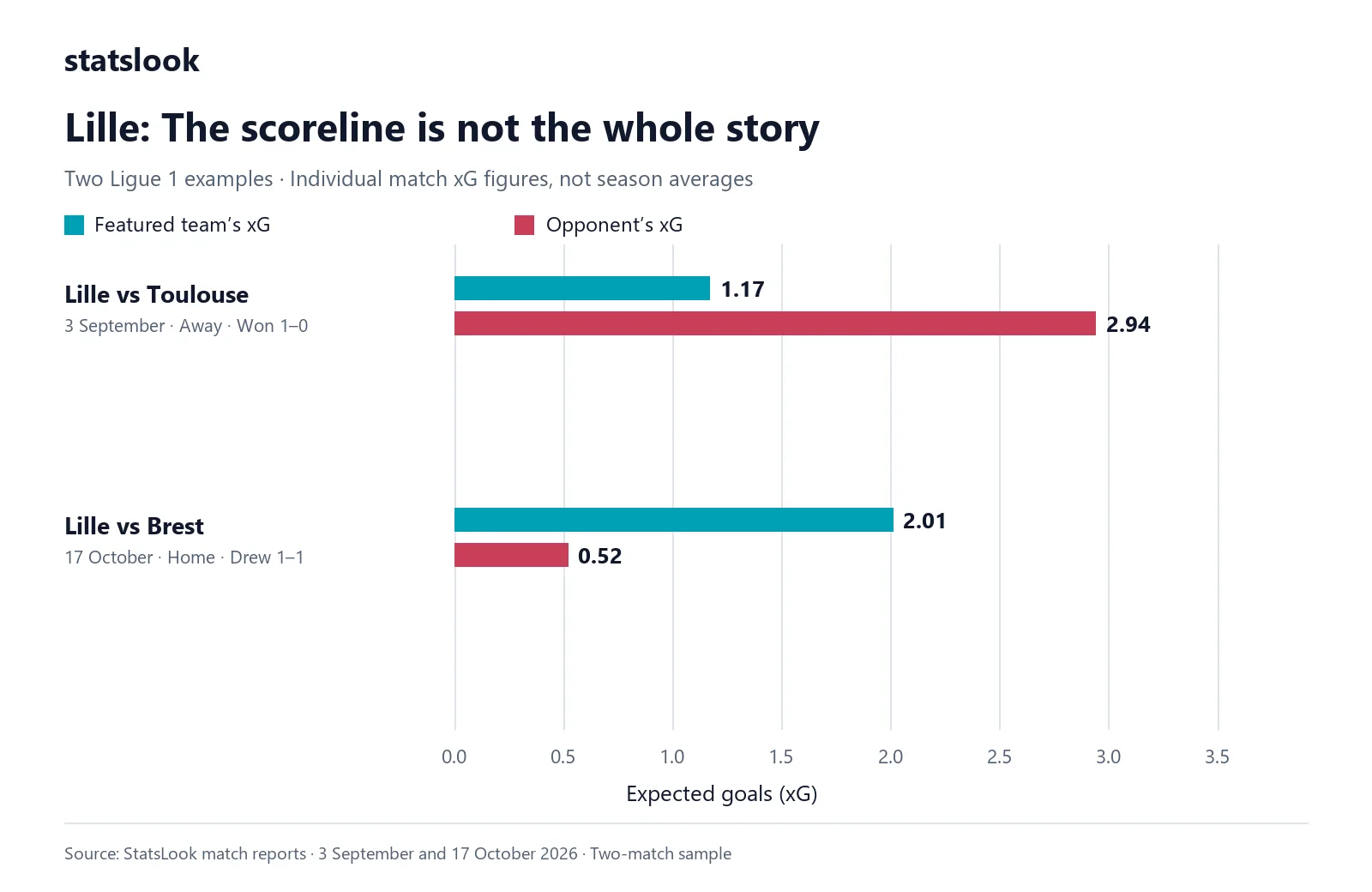
Davide Ancelotti’s side have experienced very different matches in Ligue 1. They won 1–0 away to Toulouse despite trailing 2.94 to 1.17 on xG. That victory did not come from shutting down the opposition’s chance creation.
Against Brest, the relationship between performance and result was reversed. Lille had 67% possession, generated 2.01 xG and restricted their opponents to 0.52 xG, yet drew 1–1. Olivier Giroud’s equaliser came from the penalty spot, so the penalty’s contribution must also be considered when reading Lille’s overall xG.
These two examples make it difficult to label Lille as a team who always sit back or always control possession. Galatasaray need answers for both situations: when Lille surrender the ball and when they establish their attack further up the pitch.
Lille won at Toulouse despite a lower xG total, but drew against Brest despite generating more xG. Two individual examples, not season averages. Source: StatsLook.
Three key questions for Galatasaray
Can possession become better chances?
Having 62% of the ball did not deliver the result against Sporting. Against Lille, the conditions in which Victor Osimhen receives inside the box, the timing of supporting runs and the locations of shots will be more revealing than the passing total. Moving the ball and moving the opposition defence are different achievements.
Can they regain control after a goal?
The short scoring bursts in the previous European games put the quality of each team’s response under scrutiny. Galatasaray must avoid becoming stretched while chasing a response to conceding, but also retain attacking outlets if they take the lead. These are tactical questions drawn from the reports, rather than a confirmed account of either coach’s match plan.
Can they adapt to Lille’s different attacking situations?
The Toulouse and Brest matches show Lille pursuing results under contrasting possession conditions. When Galatasaray have the ball, the space they leave behind matters. When Lille establish possession, the distances behind the first line of defensive pressure become important. Underestimating the hosts on the basis of one European scoreline would be a mistake.
Osimhen faces his former club as Leão is monitored
Osimhen’s return to face his former club adds a personal storyline. The Nigeria striker played for Lille in 2019/20, as noted in UEFA’s match preview. But relying entirely on his individual finishing would not, by itself, solve the shortage of attacking production seen against Barcelona.
Rafael Leão is another former Lille player, although Galatasaray’s medical update dated 19 October remains the relevant reference for his condition. The club reported a mild-to-moderate strain and said he would be monitored daily. The same training report stated that Wilfried Singo completed the full session with the squad. Neither update guarantees a starting place or match minutes.
The defining question in Lille vs Galatasaray
Galatasaray’s challenge extends beyond scoring first. Both clubs’ previous European games show how quickly a balanced half-time score can change. Their route to a first point depends on creating worthwhile chances while surviving opposition pressure without allowing opportunities in quick succession.
The data does not predict a scoreline. It identifies a question to follow: when the balance shifts after half-time, which team will respond better?
Data note: This analysis uses selected StatsLook match reports from the 2026/27 season. Expected goals (xG) summarises the scoring probabilities of shots; it does not guarantee the final score. Comparisons are made at match level, and two European fixtures per team are not enough to establish a definitive season-long trend.