Fenerbahçe–Sturm Graz: 29 Box Shots Reveal the Real Threat
Sturm Graz reached the next round with six goals, 5.15 xG and 29 shots from inside the box. StatsLook breaks down what awaits Fenerbahçe.

Fenerbahçe Face a Very Different Type of Opponent
Fenerbahçe are through to the UEFA Champions League third qualifying round after eliminating Górnik Zabrze. Their next opponent is Sturm Graz, who arrive after dismantling Hearts 6-0 on aggregate.
The scoreline alone suggests dominance. The underlying numbers tell a more interesting story.
Sturm had only 33% possession in the first leg and 36% in the second. Yet across those two matches they generated 5.15 xG, 37 shots, 29 shots from inside the penalty area and nine big chances.
They do not need to dominate the ball to dominate the quality of chances.
That creates the central question of this tie:
When Fenerbahçe have the ball, will they actually be controlling the match — or simply allowing Sturm Graz to play the game they prefer?
What the Previous Round Tells Us
The two teams reached this stage through very different performances.
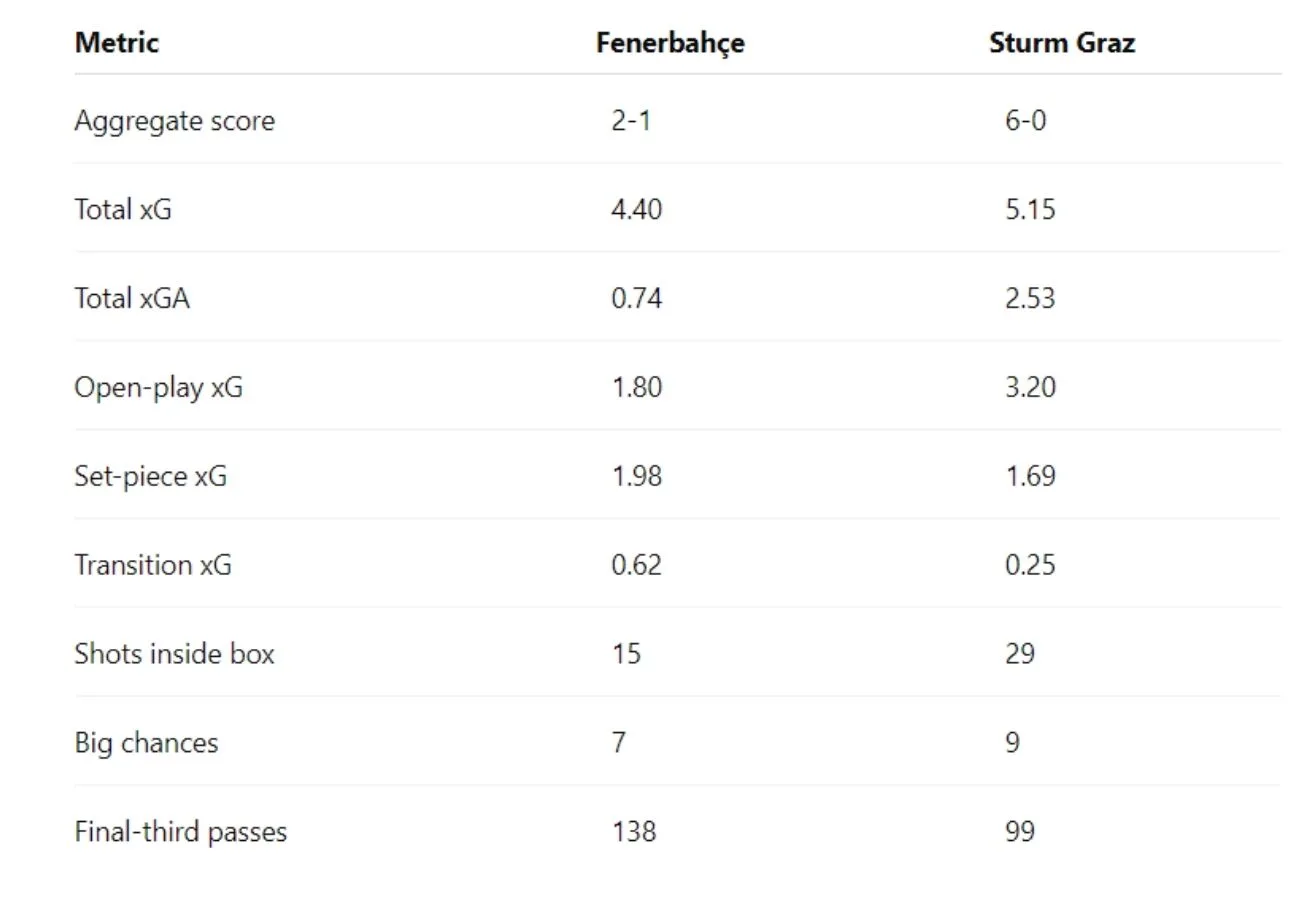
Fenerbahçe allowed Górnik only 0.74 xG across 180 minutes, while Sturm conceded 2.53 xG worth of chances to Hearts. Sturm, however, produced more attacking threat themselves, particularly inside the penalty area.
Those figures should not be treated as a direct ranking of the two teams because they came against different opponents.
What they do reveal clearly is the contrast in style.
Fenerbahçe built more of their attacking play through possession and longer passing sequences. Sturm reached dangerous areas with fewer passes and far less possession.
Sturm Graz Are More Than a Counter-Attacking Team
It would be easy to see Sturm’s low possession numbers and label them a transition side.
The xG breakdown suggests something more sophisticated.
Of Sturm’s 5.15 xG against Hearts, 3.20 came from open play, 1.69 from set pieces and only 0.25 from attacks classified as transitions following a recent ball recovery.
Their threat is therefore not simply based on winning the ball and immediately counter-attacking.
Sturm are comfortable without possession, but once they reach the attacking half they are direct, aggressive and committed to finishing attacks.
Across both legs against Hearts, they completed only 492 passes but still produced 37 shots.
That efficiency is central to their identity.
They do not need long possession sequences to get the ball into the penalty area.
A Stable 4-4-2
Sturm started both matches against Hearts in a 4-4-2 and used the same starting XI.
Daniil Khudyakov was in goal, with Jürgen Heil, Albert Vallci, Jeyland Mitchell and Emran Soglo across the defensive line.
Simon Seidl, Jon Gorenc Stankovic, Luca Weinhandl and Jacob Hödl formed the midfield, with Szymon Wlodarczyk and Seedy Jatta playing together up front.
That continuity gives Fenerbahçe a relatively clear idea of the structure they are likely to face.
The two-striker system keeps opposition centre-backs occupied, while Sturm’s midfielders and defenders aggressively attack the spaces created around them.
The distribution of their goals against Hearts is a good illustration of that threat.
Six Goals, Six Different Scorers
All six Sturm goals against Hearts were scored by different players.
Stankovic, Mitchell, Weinhandl and Heil scored in the 4-0 first-leg victory. Seidl and Soglo found the net in Edinburgh.
Neither starting striker scored.
That does not mean Wlodarczyk and Jatta were ineffective.
Together, the pair generated approximately 1.74 xG across the two matches without finding the net.
Their occupation of central defenders helped create opportunities for players arriving from deeper positions.
For Fenerbahçe, this matters.
Containing the two forwards will not be enough. Sturm can bring midfielders, full-backs and centre-backs into goalscoring positions.
Set Pieces Could Decide the Tie
One of the most important battles in this matchup could come from dead-ball situations.
Sturm generated 1.39 set-piece xG in the first leg against Hearts alone. Mitchell produced 0.84 xG in that match, while Stankovic opened the scoring with a header.
Across the two matches, Sturm’s set-piece xG reached 1.69.
But Fenerbahçe have their own major strength in exactly the same area.
Against Górnik, they generated 1.98 set-piece xG across the tie — 0.73 in Istanbul and 1.25 in Poland.
That makes set pieces a two-way tactical issue.
Fenerbahçe must deal with Sturm’s physical threat, but they also have the personnel and delivery to create serious problems at the other end.
Sturm’s 6-0 Aggregate Score Flatters Their Defensive Control
Sturm did not concede a single goal against Hearts.
That does not mean they gave up nothing.
Hearts produced 34 shots and 2.53 xG across the two games.
In Graz, they had 19 shots and generated 1.43 xG. In Edinburgh, another 15 attempts produced 1.10 xG.
Khudyakov made nine saves across the tie, including six in the first leg.
The 6-0 aggregate score therefore reflects Sturm’s attacking efficiency more clearly than complete defensive dominance.
Hearts created chances.
They simply failed to finish them.
That is one of the most encouraging pieces of evidence for Fenerbahçe.
Sturm’s defensive block can be breached.
Fenerbahçe Gave Up Far Less
Fenerbahçe’s defensive numbers against Górnik were considerably stronger.
They conceded just 0.09 xG in Istanbul and 0.65 in Poland — 0.74 across the entire tie.
But the second leg also contained a warning.
Górnik reached 15 shots in Poland and enjoyed periods of sustained pressure, particularly late in the first half. Mert Günok was required to make five saves.
Sturm showed against Hearts that they can turn relatively limited possession into much more dangerous penalty-area activity.
If Fenerbahçe allow the same kind of loss of control they experienced in Poland, the consequences could be more severe.
Fenerbahçe Created 4.40 xG — and Scored Twice
The biggest concern from Fenerbahçe’s previous round was not chance creation.
It was conversion.
Fenerbahçe generated 4.40 xG across the Górnik tie but scored only two goals.
Both were scored by Talisca.
They produced 1.60 xG in the 1-0 first-leg win and then 2.80 xG in the 1-1 draw in Poland.
Sturm, by contrast, converted 5.15 xG into six goals.
That difference could become significant in a tighter Champions League tie.
Sturm have already demonstrated that they can turn short periods of attacking momentum into goals. Fenerbahçe cannot afford to dominate territory, create chances and repeatedly leave them unfinished.
Possession Could Be a Trap
Fenerbahçe had 79% possession in the home leg against Górnik.
They completed 765 passes, held their opponent to 0.09 xG and controlled almost the entire match.
In Poland, possession dropped to 52%, although Fenerbahçe still produced 2.80 xG.
Against Sturm, a high possession percentage would be entirely unsurprising.
Hearts had 67% of the ball in Graz and 64% in Edinburgh.
They lost 4-0 and 2-0.
That is why possession itself will tell us very little about whether Fenerbahçe are controlling this tie.
The meaningful question is what happens at the end of those possessions.
Can Fenerbahçe turn the ball into penalty-area entries, shots from good locations and big chances?
Or will Sturm allow them to pass before attacking more efficiently at the opposite end?
Hearts Sent in 47 Crosses — Sturm Dealt With Them
Sturm’s defensive approach against wide attacks also deserves attention.
Hearts attempted 24 crosses in the first leg and 23 in the second.
Sturm made 91 clearances across those two matches.
The numbers suggest they were relatively comfortable allowing Hearts to deliver balls into the penalty area and then defending them.
Fenerbahçe attempted 38 crosses across their two matches against Górnik.
Simply repeating high deliveries into Sturm’s defensive line may therefore play into their strengths.
Lower cut-backs, combinations around the edge of the box and attacks into the space between full-back and centre-back could offer more value than relying on volume crossing alone.
The Real Sturm Threat Starts Inside the Box
Perhaps the most striking number from Sturm’s Hearts tie is not their six goals.
It is the location of their shots.
They took 29 shots from inside the penalty area across the two matches.
Fenerbahçe managed 15 against Górnik.
In Graz, 16 of Sturm’s 20 attempts came from inside the box.
In Edinburgh, it was 13 of 17.
This is a team that does not simply settle for shooting from distance.
Their attacks repeatedly reach dangerous finishing zones.
For Fenerbahçe, protecting the space between the centre-backs and midfield — and then dealing with second runners — will be one of the central defensive tasks of the tie.
The Strikers Have Not Scored, but They Still Matter
Wlodarczyk and Jatta failed to score against Hearts, yet their combined xG shows how frequently they reached dangerous positions.
Jatta generated 0.64 xG in the first leg and 0.39 in the second.
Wlodarczyk recorded 0.36 and 0.35 respectively.
Their presence pins defenders centrally and creates spaces for players such as Seidl, Stankovic and Sturm’s wide defenders to arrive from deeper areas.
That creates a difficult decision for Fenerbahçe’s centre-backs.
Stay tightly connected to the forwards and runners may appear behind them.
Step out too aggressively and Sturm’s front two can attack the vacated space.
Jeyland Mitchell Is a Set-Piece Warning
Jeyland Mitchell is one individual Fenerbahçe will need to track carefully.
Although a defender, he generated 0.84 xG from three shots in the first match and scored. He added another 0.25 xG opportunity in the return leg.
That gives him 1.09 xG across the tie from a defensive position.
His numbers reinforce a broader point: Sturm’s threat on dead balls comes from multiple targets.
Marking the strikers alone will not solve the problem.
Where Fenerbahçe Can Hurt Sturm
For all the strength of Sturm’s aggregate score, Hearts still reached 2.53 xG and produced 19 shots from inside the penalty area.
There will be opportunities.
Fenerbahçe’s own set-piece production against Górnik gives them an obvious route to goal. They also showed in the second leg that Talisca, Fred, Škriniar and İsmail Yüksek could all reach valuable shooting positions.
The evidence does not suggest that Fenerbahçe will struggle to create anything against Sturm.
The more relevant question is whether they can convert their chances at a better rate than they did in the previous round.
Where Sturm Can Hurt Fenerbahçe
Sturm’s best route into the tie may come when Fenerbahçe lose their compactness after possession turns over or fail to control second balls around the penalty area.
There is an important distinction here.
The Hearts data does not describe Sturm as a team producing huge amounts of transition xG.
But it does describe a team capable of moving from limited possession to dangerous penalty-area situations very quickly.
Fenerbahçe’s periods of lost control in the second leg against Górnik are therefore relevant.
Górnik did not produce the same quality of chances as Sturm, yet still forced Fenerbahçe backwards for stretches and made Günok work.
Giving Sturm the same opportunities to establish attacks close to goal would be considerably more dangerous.
The Tie Could Be Decided by What “Control” Really Means
Fenerbahçe and Sturm Graz succeeded in the previous round through almost opposite methods.
Fenerbahçe used more possession, more passing and stronger suppression of their opponent’s attack.
Sturm accepted long periods without the ball and still created greater penalty-area threat.
Fenerbahçe made 138 final-third passes across their tie and produced 4.40 xG.
Sturm needed only 99 final-third passes to generate 5.15 xG.
That contrast captures the matchup better than possession percentages ever could.
Fenerbahçe may play more football. Sturm may need less football to cause damage.
What the Data Says About the Tie
Fenerbahçe’s defensive control was stronger in the previous round. Allowing only 0.74 xG over 180 minutes is difficult to ignore.
Sturm’s attacking profile, however, was considerably more explosive.
They produced 5.15 xG, 29 shots from inside the box and nine big chances, with six different players scoring.
At the same time, their 6-0 aggregate win should not disguise the fact that Hearts reached 2.53 xG and forced Khudyakov into nine saves.
This is therefore not simply a matchup between a possession side and a counter-attacking side.
Three areas could shape the tie: Fenerbahçe’s ability to finish the chances they create, their control of Sturm’s penalty-area runs, and the battle at set pieces.
Fenerbahçe scored only twice from 4.40 xG against Górnik.
Sturm scored six times from 5.15 xG against Hearts.
In a Champions League qualifier, that difference in efficiency can matter as much as anything on the tactical board.
Fenerbahçe’s real challenge against Sturm Graz will not be to have more of the ball. It will be to make their possession more valuable than Sturm make theirs.