From the Hand of God to Atlanta: The 40-Year Shadow Over England vs Argentina
England and Argentina meet once again in a World Cup semi-final. We trace the story of their 40-year rivalry, from the 1986 "Hand of God" goal to the lingering shadow of the Falklands War.
More Than Just a Match
England and Argentina meet in the World Cup semi-final in Atlanta on July 15, 2026. But the football rivalry between these two nations carries a history that goes far beyond an ordinary international fixture. Its roots actually stretch back to the 1966 World Cup, but the 1982 Falklands War added a much deeper, more political dimension to the rivalry.
The Falklands War: The Real Conflict Off the Pitch
In 1982, England and Argentina went to war over the sovereignty of the Falkland Islands (known to Argentina as "Las Malvinas") in the South Atlantic. After the Argentine military invaded the islands, Britain sent a naval task force that recaptured them. Although the two nations never officially declared war, the conflict claimed 649 Argentine soldiers, 255 British soldiers, and 3 civilians.
1986: The Day History Was Written at the Azteca
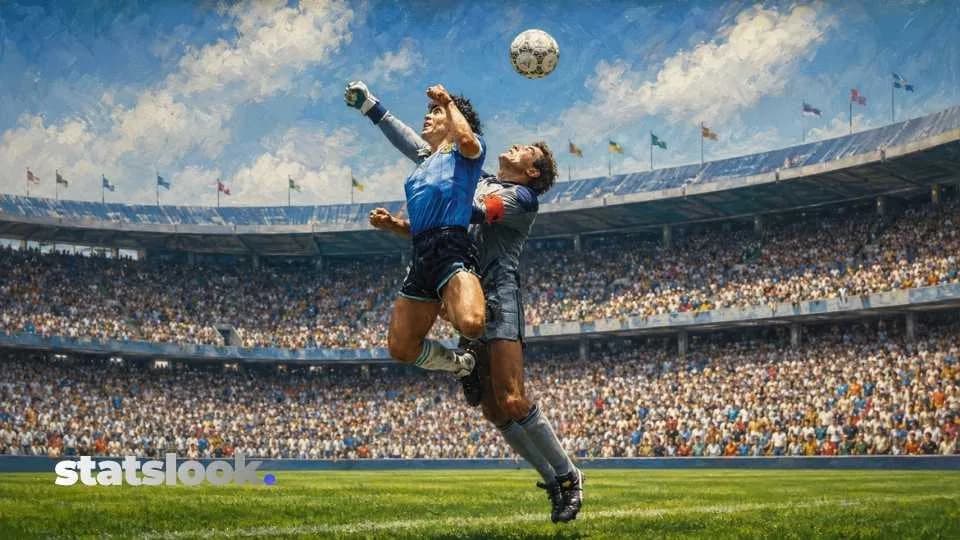
Exactly four years after the war, on June 22, 1986, the quarter-final match played at the Estadio Azteca in Mexico City became one of the most controversial and unforgettable moments in football history. In the 51st minute, Diego Maradona beat goalkeeper Peter Shilton to the ball and punched it into the net with his hand. Tunisian referee Ali Bin Nasser allowed the goal to stand, and the England players' protests changed nothing.
At the post-match press conference, Maradona immortalized the goal by saying it was scored "a little with the head of Maradona, and a little with the hand of God" — a phrase that gave the goal its enduring name: the "Hand of God."
Just four minutes later, Maradona picked up the ball in midfield and dribbled past five England players to score what would become known as the "Goal of the Century." FIFA later recognized it as one of the greatest goals in the tournament's history. The match ended 2-1 in Argentina's favor, and Argentina went on to win the tournament as champions.
Maradona's Own Confession
Years later, Maradona admitted to the emotional weight behind that goal. He said the match had never been treated as a mere friendly beforehand — instead, everyone went into it seeking honor and revenge. He acknowledged knowing it was his hand, but chose to call it the "Hand of God" anyway. Argentina's coach at the time, César Luis Menotti, said people took satisfaction in the goal's very unfairness, precisely because it hurt England more.
The Rivalry's Later Chapters
The two sides met again at the 1998 World Cup; the match finished 2-2 after extra time, with Argentina winning 4-3 on penalties to advance to the quarter-finals. In 2002, England won 1-0 thanks to a penalty from David Beckham — this time it was Argentina who were eliminated.
Arriving at 2026: History Resurfaces
Ahead of today's semi-final, the historical tension appears to have flared up off the pitch as well. Argentina's Foreign Minister Pablo Quirno recently revived the sovereignty claim over the Falkland Islands, describing Britain's presence there as an "illegitimate occupation." On the English side, opposition foreign affairs spokesperson Priti Patel responded firmly, stating that the Falkland Islanders' right to self-determination is not up for debate.
Comments from Argentine President Javier Milei — asserting that the islands "were Argentina's in the past, are Argentina's today, and will always be Argentina's" — further underline the ongoing political dimension of this tension. Argentine players were also noted chanting references to Las Malvinas and Maradona after eliminating Egypt to reach the semi-final.
Given this historically charged atmosphere, security in Atlanta has been raised to a high level, with authorities confirming additional personnel deployed to prevent potential tensions among fans.
Today's Stage: Messi's Final Curtain?
This semi-final also carries another symbolic weight: Argentina's legendary captain Lionel Messi will face England in a World Cup match for the first time in his career. The presence of chants referencing "Diego Maradona" and "Messi's final tournament" among Argentine fans makes clear just how directly the legacy of 1986 carries into the present.
Conclusion
What happened at the Azteca 40 years ago still looms over the match about to be played in Atlanta. Beyond the 22 players on the pitch, this fixture will be remembered as a moment where the two nations' shared history, political tension, and football mythology all intersect once again. The legacy of the Hand of God will once again be tested on the pitch.