Champions League Night Analysis: What the Scorelines Hid Across Six Matches
Six Champions League matches produced 21 goals, but the scorelines told only part of the story. StatsLook data reveals Madrid’s missed opportunities, Villa’s attacking efficiency and Betis’ comeback.
What 21 Goals Across Six Champions League Matches Really Told Us
The opening night of the 2026/27 Champions League produced six matches, 21 goals and no draws.
Aston Villa, Manchester City and Real Betis won away from home, while Real Madrid, Borussia Dortmund and AEK collected three points on their own grounds.
Three of the six matches finished 3-2, but those identical scorelines came from very different game states.
Aston Villa created the better chances despite having much less possession. Real Betis came from behind twice before completing their turnaround. Borussia Dortmund, meanwhile, had to re-establish control after Villarreal equalised in the second half.
The StatsLook match reports reveal several stories that the final scores alone cannot explain.
Club Brugge 2-3 Aston Villa: Possession Did Not Mean Attacking Control
Club Brugge finished with 64% possession, but Aston Villa were the more productive attacking side.
Villa led the shot count 21-14 and created four big chances to Brugge’s two.
That makes it difficult to explain the 3-2 victory simply through superior finishing.
Villa did not merely convert their opportunities better. They also generated more of them.
The clearest difference came from open play.
Aston Villa produced 1.76 open-play xG, while Club Brugge managed only 0.62.
Brugge, by contrast, generated 61% of their total xG from set pieces.
Their higher possession share therefore did not translate into comparable open-play threat.
Game state also matters. Villa went into half-time with a 3-1 lead, meaning Brugge spent the second half chasing the match. The final possession numbers cannot be separated from that context.
Why Pau Torres’ Four Key Passes Matter
The contrast becomes even more interesting when looking at the centre-backs.
Club Brugge defenders Han-beom Lee and Brandon Mechele attempted 100 and 96 passes respectively.
Neither produced a key pass.
Pau Torres attempted only 41 passes for Aston Villa but created four shots with key passes, matching John McGinn for the highest total in the Villa side.
That does not mean every centre-back should be expected to perform the same role.
It does, however, show the difference between circulating the ball and using possession to directly improve the attack.
Torres also made eight clearances, combining defensive responsibility inside his own box with progressive contribution at the other end.
Villa’s lower possession should not automatically be described as counter-attacking football either.
In the report’s transition category — defined as xG generated within 10 seconds of winning the ball — Villa recorded 0.00 xG.
That does not prove there were no counter-attacks, but it does show that their open-play production cannot simply be attributed to transition attacks.
AEK 1-0 LASK: The Strikers Missed, Marin Delivered
Răzvan Marin scored the only goal in AEK’s 1-0 victory, but his influence went much further than the finish in the 21st minute.
The Romanian midfielder produced five key passes, the highest figure in the team, and won eight of his 13 duels.
The forwards had a much more frustrating evening.
Luka Jović, Barnabás Varga and substitute Zini combined for 1.22 xG without scoring.
Together, they missed four big chances.
AEK therefore did not finish with only one goal because they lacked opportunities.
Their centre-forwards reached dangerous positions but failed to convert them, leaving a midfielder to provide the decisive finish.
Why Did LASK’s Pressure Disappear?
LASK’s strongest attacking period came immediately after half-time.
Between minutes 46 and 60, they generated four shots and 0.44 xG.
Over the following half-hour, however, they managed only one attempt.
AEK, by contrast, produced six shots in the final period of the match, their highest 15-minute shot total.
So this was not simply a case of scoring early and protecting the lead.
AEK continued to create late in the game, while LASK could not sustain the pressure required to find an equaliser.
Aboubakary Koita also deserves attention.
The left winger won 12 of 16 duels, the highest total in the match, while adding three tackles and three shots.
It was a significant contribution that did not appear on the scoresheet.
Porto 0-2 Manchester City: Haaland Had More Shots Than Porto
The most striking number from Manchester City’s 2-0 victory in Porto was the home side’s zero shots on target.
Porto attempted only five shots, generated 0.30 xG and failed to create a big chance.
Manchester City produced 10 shots on target, six big chances and 2.27 xG.
With 64% possession, City’s control of the ball was matched by their ability to prevent Porto from creating meaningful attacking threat.
Erling Haaland opened the scoring in the 47th minute.
Porto then had to chase the match but still failed to register a shot on target before City added their second in the 90th minute.
The score remained close for most of the second half.
The underlying attacking numbers were not.
Haaland’s Finishing Quality
Haaland attempted six shots — one more than Porto managed as an entire team.
Those efforts produced 1.15 xG and two goals.
His shots on target generated 2.52 xGOT.
xG and xGOT measure different stages of the shooting process, but together they tell an important story here.
Haaland not only found good scoring positions; the placement of his shots increased the difficulty for the goalkeeper after contact.
His performance combined chance quality with finishing quality.
Porto’s inability to produce comparable threat at the other end completed the picture.
Real Madrid 2-1 Inter: The Goals Came Early, the Best Chances Came Later
Real Madrid established an early advantage through Kylian Mbappé in the 14th minute and Federico Valverde nine minutes later.
Inter had more possession and attempted more shots, but Madrid created the better chances.
Inter finished with 21 shots to Madrid’s 16.
Yet Real Madrid led 8-4 in big chances and 3.77-2.03 in xG.
Dividing total xG by shot volume gives Madrid an average of approximately 0.24 xG per attempt, compared with around 0.10 for Inter.
Inter created volume.
Madrid created quality.
When Could Madrid Have Put the Game Away?
The most interesting part of Madrid’s performance came after their two goals.
Between minutes 46 and 75, Real Madrid produced 12 shots and 2.27 xG.
They did not score once during that half-hour.
Inter generated eight shots and 0.71 xG over the same period.
Madrid therefore spent much of the second half creating opportunities to make the game comfortable — and failing to convert them.
Carlos Augusto reduced the deficit in the 77th minute, suddenly making the closing stages much tighter.
That is why the 2-1 scoreline understates Madrid’s attacking performance.
They did not simply protect an early lead.
They created enough second-half chances to extend it but left the match open through missed opportunities.
Lille 2-3 Real Betis: The Comeback Was Complete Before the Red Card
Lille went ahead twice.
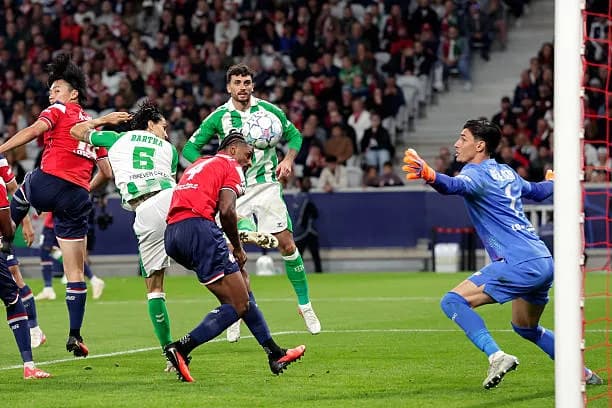
Marc Bartra equalised twice.
The Betis centre-back made it 1-1 in the 33rd minute and 2-2 in the 49th before Troy Parrott put the visitors ahead four minutes later.
Ethan Mbappé was then sent off in the 56th minute.
The sequence matters.
By the time Betis gained a numerical advantage, the comeback had already been completed.
Their momentum had also begun before half-time.
Betis generated six shots and 0.78 xG between minutes 31 and 45, showing that the pressure behind the turnaround was already developing before the break.
Lille’s red card made their task considerably harder, but attributing Betis’ victory solely to the dismissal would ignore what happened beforehand.
Bartra’s Goals Did Not Extend a Lead — They Rebuilt the Match
Bartra scored twice from just two shots worth a combined 0.39 xG.
Both goals brought Betis back level.
He also contributed seven clearances and won five aerial duels, while completing 60 of his 69 passes.
His performance was therefore far broader than an unusual two-goal return from a centre-back.
Lille, meanwhile, failed to attempt a shot during the first 30 minutes of the second half.
While Betis transformed the scoreline, the home side lost its attacking response.
The result reflected both Bartra’s exceptional finishing and Lille’s inability to generate pressure during a decisive phase.
Borussia Dortmund 3-2 Villarreal: Dortmund Regained the Initiative After the Equaliser
The final half-hour of Dortmund’s 3-2 victory can be divided into two very different phases.
Between minutes 61 and 75, Villarreal attempted six shots compared with Dortmund’s three.
Santiago Mouriño’s equaliser in the 66th minute came during that period of growing Villarreal pressure.
Then the balance changed again.
Across the final 15 minutes, Dortmund led the shot count 6-2.
Serhou Guirassy restored Dortmund’s advantage in the 80th minute and added a penalty five minutes later.
Villarreal had succeeded in taking control long enough to equalise.
They could not sustain it.
Guirassy’s own goal in the 90th minute reduced the final margin to 3-2, but the decisive stretch had already come when Dortmund responded to 1-1 by increasing their attacking output again.
Guirassy Produced Almost 70% of Dortmund’s xG
Guirassy touched the ball only 34 times.
Yet he attempted six of Dortmund’s 18 shots.
His 1.91 xG accounted for roughly 69% of Dortmund’s total 2.75 xG, with the penalty included in that figure.
He also created two chances, won seven duels and claimed four aerial duels.
This was therefore more than a pure finishing performance.
Guirassy was responsible for a large share of Dortmund’s shooting output while also contributing to the attacks of those around him.
Six Matches, Six Different Explanations
The first Champions League night offered several reminders about how misleading scorelines can be when viewed without context.
Aston Villa won with far less possession but superior open-play production.
AEK created enough chances for a larger scoreline but needed Marin to provide the finish their forwards could not.
Manchester City dominated both ends of the pitch, with Haaland alone attempting more shots than Porto.
Real Madrid won 2-1 but generated enough second-half quality to decide the match much earlier.
Real Betis completed their comeback before Lille’s red card.
Dortmund temporarily lost momentum after Villarreal’s equaliser, then regained control when the match reached its decisive phase.
The common thread is simple:
The score tells us what happened. The underlying numbers help explain how it happened.