Brighton Have Rebuilt Again. Their Start Is Real — but the Defence Is Not Yet.
Brighton sit third after five Premier League matches despite a summer of major departures. League-leading attacking numbers validate the start, but a bottom-four xGA rank reveals the risk beneath it.

The first five matches are not simply a good start
Brighton & Hove Albion have taken 10 points from five Premier League matches, scored 16 goals and moved into third place. On the surface, that is an outstanding start. In context, it is much more revealing.
This was supposed to be the summer in which Brighton’s succession model faced its hardest test yet. Carlos Baleba left for Manchester United, Jan Paul van Hecke joined Tottenham and Danny Welbeck moved to Chelsea. Joël Veltman departed, James Milner retired and a sizeable intake had to be integrated quickly. Brighton did not just lose one star; they removed influential players from the spine of the team.
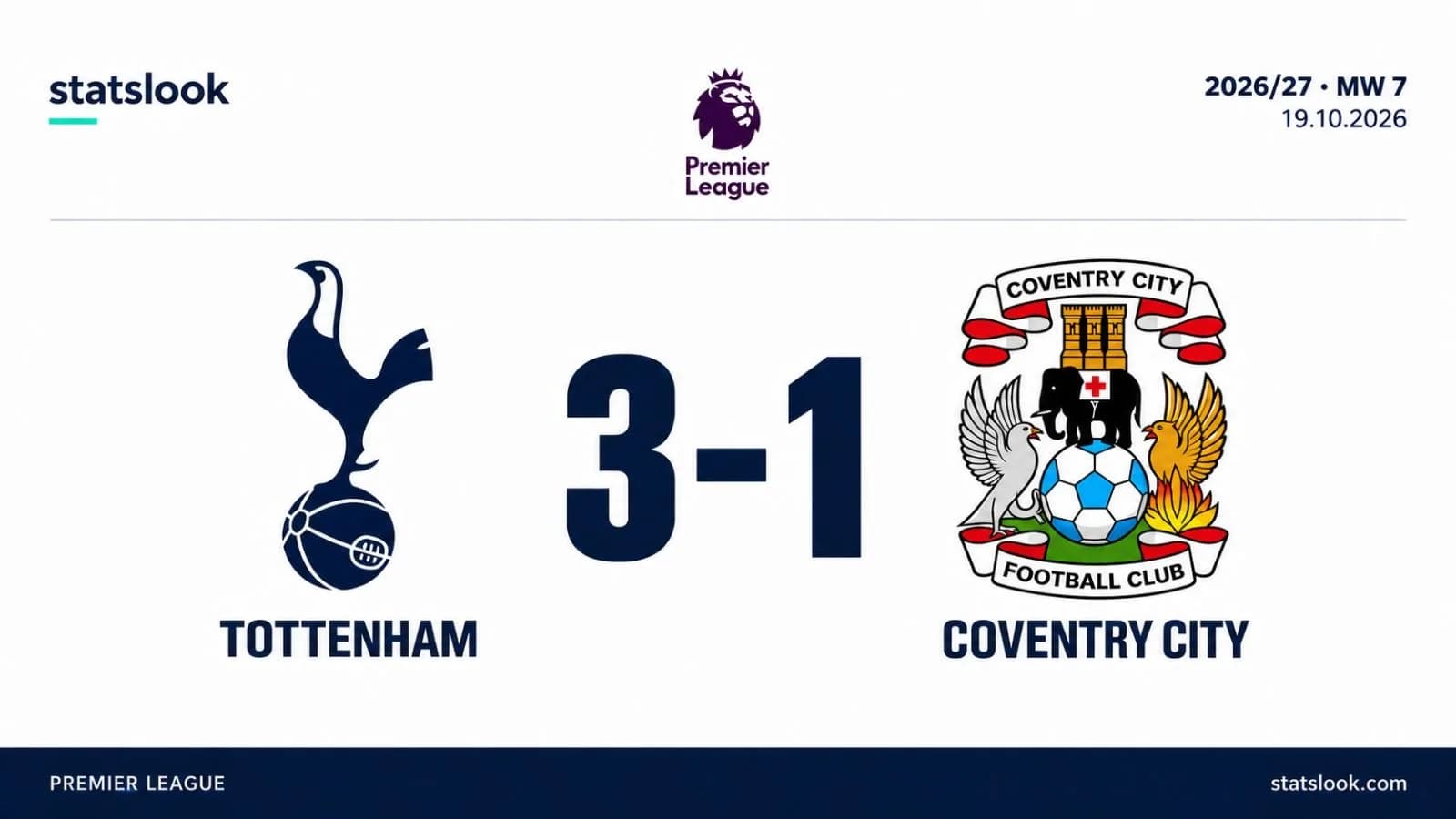
Instead, Fabian Hürzeler’s side have opened the campaign with three wins, a draw and one defeat. The 3-0 win over reigning champions Arsenal — on the club’s 125th anniversary — was the clearest statement, but it was not an isolated result. A 5-0 away win at Coventry and 16 goals in five league games point to a team whose attacking process is already functioning.
The important distinction is this: Brighton have not started well despite their rebuild. They have started well because the rebuild has already fed the system.
The league’s best attack by almost every early indicator
Brighton’s team statistics place them first in the Premier League for goals scored, expected goals, shots on target, big chances and possession after five matches.
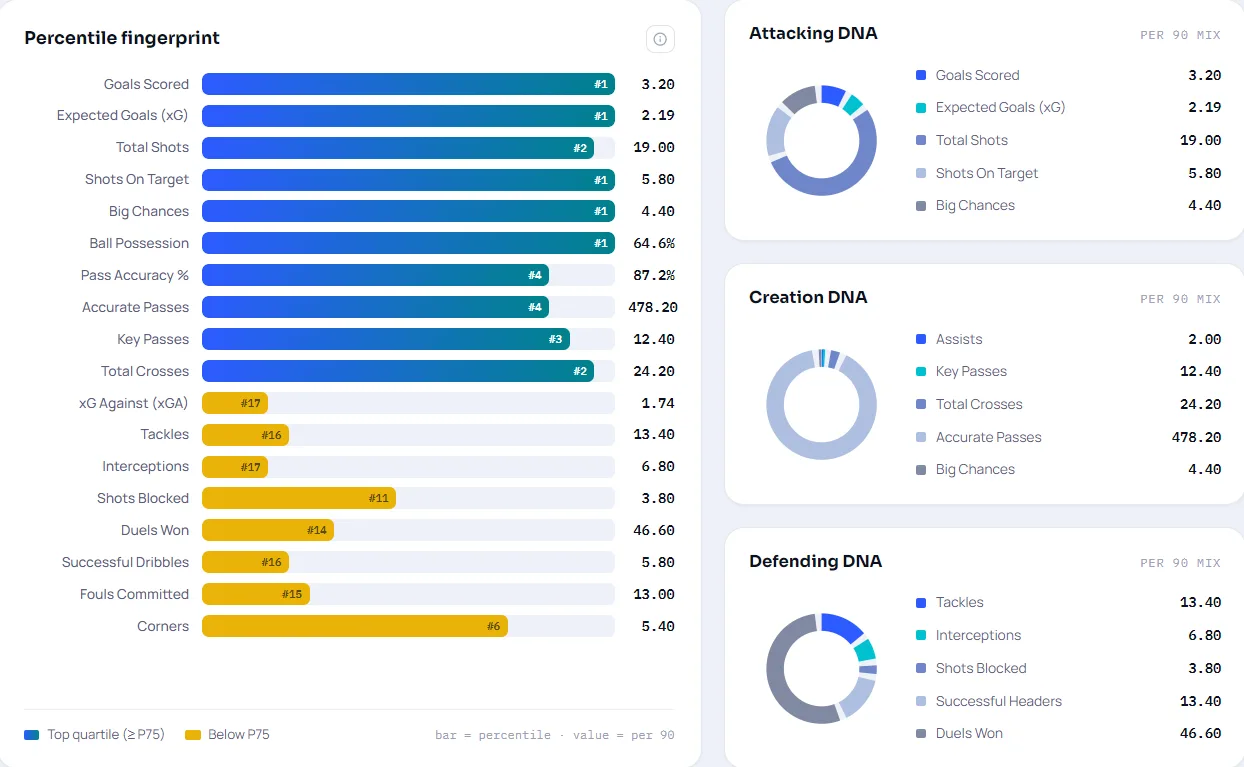
The headline number is 16 goals, but the more useful one is 2.19 xG per game. It shows that Brighton’s scoring is not merely the result of a hot shooting spell or a sequence of favourable bounces. They are creating a league-leading volume of chances.
They are also scoring above that underlying level: 16 goals from roughly 10.95 xG. That gap will not necessarily persist, and it should not be treated as a permanent standard. But the process is strong enough that some regression would not erase Brighton’s attacking quality.
Their chance creation is varied too. Brighton rank near the top for key passes, crosses and accurate passes, while leading the league in possession at 64.6%. This is not a side surviving on transition bursts alone. It is controlling territory, moving the ball consistently and reaching the box through multiple routes.
A system no longer dependent on one scorer
Welbeck’s departure appeared, on paper, to leave Brighton without their most familiar finishing reference point. The opening weeks have instead shown a more distributed attack — and Brighton’s player statistics make that spread of contribution visible.
Pascal Groß has brought senior control and decisive end product, including the opener against Arsenal. Nineteen-year-old Charalampos Kostoulas has made an immediate impact, while deadline-day signing Chema Andrés scored in his first league start against Arsenal. The significance is not that each individual has already become a star; it is that the structure has kept producing runners, creators and finishers without needing one player to carry the entire attacking load.
That is the clearest sign that the recruitment model is working. Brighton have often sold at the moment an elite player’s value peaks. This time, losing Baleba, Van Hecke and Welbeck at once risked stripping the team’s identity. Early evidence suggests the club have not simply bought replacements; they have replenished roles inside an established playing model. Their outgoing and incoming profiles can be assessed side by side with StatsLook’s Player Comparison tool.
Hürzeler’s identity starts before the first pass
Hürzeler described the Arsenal performance through the basic moments: the first tackle, first header and first throw-in. It is a telling description of this Brighton side.
The data-backed image is a possession-heavy team, but the emotional and tactical trigger is more physical. Brighton want the first duel, then the second ball, then the territorial advantage that allows their passing game to take over. That is why the Arsenal result matters beyond the scoreline: Brighton did not sit deep and wait for a mistake. They imposed intensity on the champions.
The same pattern helps explain the volume of chances. A team averaging 19 shots and 4.4 big chances per match is not only patient in possession; it is repeatedly turning pressure into entries into high-value areas.
The early warning sits on the other side of the ball
The opening numbers are not flawless. Brighton have conceded only five goals and kept three clean sheets, which looks excellent. Their xGA says the defensive performance has been less secure than those results imply.
At 1.74 xGA per match, Brighton rank 17th in the league. Across five matches, that is roughly 8.7 expected goals conceded — substantially higher than the five they have actually allowed.
This does not mean Brighton have been poor defensively in every match. It does mean the current clean-sheet count deserves caution. They also rank 16th for tackles, 17th for interceptions and 14th for duels won. Those rankings do not prove a weak defence on their own, especially for a possession-dominant side that naturally has fewer defensive actions. But alongside the xGA, they point to a real issue: when opponents do get through Brighton’s first layers, the chances can be too valuable.
That is the part of the start Hürzeler has to solve. Brighton can sustain an attack that occasionally underperforms its xG. It is much harder to sustain a season in which opponents repeatedly create chances worth 1.74 xG per game.
A genuine top-four case, with one condition
Brighton are not third by accident. The attacking platform is league-leading: chance volume, shot quality, possession and creation all support the points total. The post-sale rebuild also looks much further advanced than it had any right to be in September.
But this is not yet a complete team. Brighton are currently scoring more than their xG and conceding fewer goals than their xGA. The first may cool; the second is the more urgent concern.
If Hürzeler can reduce the quality of the chances Brighton concede without dulling the pressure and possession that make them so dangerous, this opening will look like the start of a serious European race. If not, the same games that now end in clean sheets may start becoming open, costly shootouts.
Brighton have proved they can replace talent. Their next task is to make the defensive side of the replacement cycle as convincing as the attacking one. Explore their full squad, fixture and team-data profile on StatsLook.
Sources: StatsLook 2026/27 Premier League team data; Premier League; The Guardian; talkSPORT.