Bilal El Khannouss Scout Report: 9 Goals, 8 Assists and a Changing Role
Bilal El Khannouss has evolved from a creative connector at Leicester into a higher-impact attacking midfielder at Stuttgart, combining 9 goals with 8 assists.

Who Is Bilal El Khannouss?
Bilal El Khannouss was born on May 10, 2004 in Strombeek-Bever, Belgium, and represents Morocco at international level.
The right-footed attacking midfielder stands at 1.80 metres and has developed through a pathway that took him from Anderlecht’s academy to Genk, Leicester City and eventually VfB Stuttgart.
According to the background information provided, El Khannouss started playing football at Crossing Schaerbeek before joining Anderlecht at a young age. In 2019, he moved to Genk in search of greater playing opportunities.
His later progression through Leicester and Stuttgart provides an interesting development curve because the numbers suggest more than a simple improvement in output.
The role itself has changed.
At Leicester, El Khannouss looked primarily like a creative midfielder capable of carrying the ball and connecting attacks.
At Stuttgart, he has added a much stronger scoring dimension.
From Leicester to Stuttgart: A Major Attacking Jump
The difference between his last two seasons is significant.
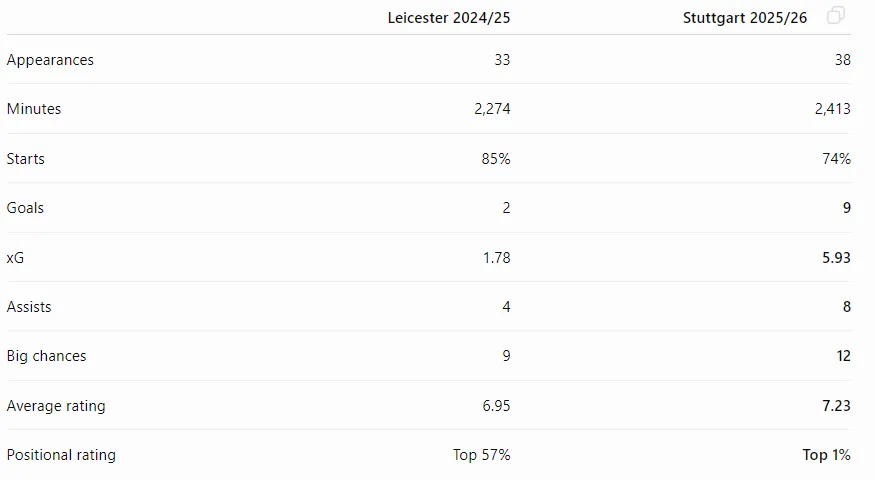
His playing time increased by only 139 minutes.
Yet his goal total rose from two to nine, while his assists doubled from four to eight.
That is not simply a volume effect.
El Khannouss went from six direct goal contributions in 2024/25 to 17 in 2025/26.
The more important development is how he started influencing the final phase of attacks.
Leicester: Creative, Mobile, but Far From Goal
In the 2024/25 Premier League season, El Khannouss produced a profile built more around progression and combination play than direct scoring.
Per 90 minutes among Premier League attacking midfielders with at least 450 minutes, he recorded:
0.08 goals — #29
0.16 assists — #20
0.07 xG — #31
1.70 key passes — #17
0.36 big chances — #12
1.23 shots — #26
0.29 shots on target — #27
1.39 successful dribbles — #12
56.04 touches — #17
31.46 accurate passes — #15
79.5% pass accuracy — #21
The message from those numbers is fairly clear.
El Khannouss was involved in possession but did not consistently arrive in dangerous scoring zones.
His 0.07 xG and 1.23 shots per 90 were particularly low for an attacking midfielder expected to contribute near goal.
His stronger areas were ball progression, dribbling and chance creation.
The Leicester version of El Khannouss was closer to:
receive → escape pressure → connect → create
At Stuttgart, another stage was added:
finish.
Stuttgart: The Goal Threat Arrived
His shooting profile changed dramatically in Germany.
Shots per 90 increased from:
1.23 to 2.69
At the same time:
xG increased from 0.07 to 0.22
Shots on target rose from 0.29 to 1.01
Goals increased from 0.08 to 0.36 per 90
Among Bundesliga attacking midfielders, he ranked:
#5 for goals
#5 for total shots
#8 for shots on target
This is one of the most important developments in his profile.
El Khannouss is no longer only a player who helps create the attack.
He has become a midfielder who can arrive in scoring positions and finish them himself.
9 Goals From 5.93 xG: How Should We Read It?
El Khannouss scored nine goals from 5.93 xG in 2025/26.
That represents an overperformance of approximately:
+3.07 goals
It is a positive finishing signal, but it should not automatically be treated as proof that he is now an elite finisher.
One-season xG overperformance can fluctuate.
The more sustainable development is that his overall xG volume increased from 1.78 to 5.93 across all competitions.
That means he did not simply convert the same opportunities more efficiently.
He started getting into far more dangerous positions.
For scouting purposes, that change is arguably more important than the finishing overperformance itself.
His Best Trait Remains Creativity
Despite the rise in goals, creativity is still the foundation of El Khannouss’ game.
He averaged 2.46 key passes per 90, ranking #2 among Bundesliga attacking midfielders.
He also produced:
0.30 assists — #8
0.45 big chances — #9
4.51 crosses — #7
0.28 through balls — #13
This combination matters.
He is not a low-touch attacking midfielder who waits for the final action.
He participates heavily in the build-up and then remains involved when the attack reaches the final third.
That makes him more than a conventional No.10.
A better description would be:
a high-involvement attacking playmaker.
70.83 Touches Per 90: Constantly Involved
One of the strongest indicators of El Khannouss’ role is his touch volume.
He averaged:
70.83 touches per 90 — #4 among Bundesliga attacking midfielders
He also completed:
41.55 accurate passes per 90 — #5
Those numbers show that his nine goals and eight assists did not come from a low-volume final-third role.
He wants the ball repeatedly.
He can receive deeper, participate in circulation, move into a new position and then become involved again closer to goal.
This is an important distinction when considering his future role.
El Khannouss does not need to be hidden between the lines and fed only for the final pass.
He can become part of the structure that gets the team there.
Playmaker or Ball Carrier?
Both, although his game has become increasingly pass-oriented.
At Leicester, he averaged:
1.39 successful dribbles per 90
At Stuttgart:
1.04
At the same time:
Key passes increased from 1.70 to 2.46
Touches rose from 56.04 to 70.83
Accurate passes increased from 31.46 to 41.55
That suggests an interesting evolution.
Rather than increasing his value primarily through individual carrying, he is increasingly controlling attacks through passing, positioning and repeated involvement.
The provided background also notes that he played futsal during his development, which fits with the close-control and tight-space qualities associated with his game.
His Stuttgart version appears less dependent on beating opponents individually and more capable of manipulating the game through the ball.
Why Is He Effective in Tight Areas?
El Khannouss’ technical profile is built around three connected qualities:
first touch, body orientation and vision.
His touch volume combined with an 81.6% pass completion rate shows that he can handle significant possession responsibility without becoming overly wasteful.
The percentage itself must also be viewed in context.
An attacking midfielder is expected to attempt more difficult passes than a centre-back or deep midfielder.
Maintaining 81.6% while producing 2.46 key passes per 90 is therefore more meaningful than the raw completion percentage alone.
His job is not simply to protect possession.
It is to break defensive structures.
More of an Interior Than a Touchline Winger
El Khannouss can operate in several attacking positions, but his data points towards central and half-space roles.
His best situations are not necessarily isolated one-v-one moments on the touchline.
He is more dangerous when he receives between midfield and defence with his body open towards goal.
From there he can:
Shoot
Play into the penalty area
Release a wide runner
Combine with the striker
Switch play
Make a late run into the box
A central No.10 role in a 4-2-3-1 naturally suits him.
He could also function as an attacking No.8 in a possession-oriented 4-3-3 or as an inverted wide midfielder allowed to move inside.
The key is less about the position label and more about keeping him close to the ball and close to combinations.
Why the Scoring Evolution Matters
Modern attacking midfielders are increasingly expected to provide more than creativity.
Top-level teams often need a secondary scoring source from the No.10 or advanced No.8 role.
El Khannouss averaged approximately:
0.36 goals + 0.30 assists per 90
That gives him around 0.66 direct goal contributions per 90.
Combining that with 2.46 key passes is what makes the profile particularly interesting.
Some attacking midfielders create but rarely score.
Others score but contribute little to the organisation of attacks.
El Khannouss’ 2025/26 season suggests he is beginning to do both.
What Does He Offer Without the Ball?
El Khannouss is not purely an on-ball attacking midfielder.
His Bundesliga defensive numbers included:
1.60 tackles — #13
0.60 interceptions — #16
4.29 duels won — #19
0.97 aerial duels won — #9
3.24 ball recoveries — #29
These numbers do not make him an elite defensive midfielder or pressing specialist.
However, they do show that he is not completely detached from defensive phases.
The aerial number is particularly interesting for a 1.80m, 70kg attacking midfielder.
His Leicester season also featured 2.06 tackles per 90, indicating that he carried more defensive responsibility in England.
The drop to 1.60 tackles in Germany, combined with the rise in attacking output, may reflect a more offensive role at Stuttgart.
Because these numbers come from different teams and different leagues, that should be viewed as a directional trend rather than definitive proof of a tactical role change.
Why the Premier League Season Still Matters
El Khannouss’ Leicester numbers look modest compared with his Stuttgart output.
He produced only two goals and four assists across 33 appearances.
But the season still had developmental value.
He played 2,274 minutes in the Premier League at a young age and produced:
1.39 successful dribbles per 90
2.06 tackles
4.75 duels won
That experience exposed him to higher physical intensity and greater defensive demands.
It would be speculative to say that this directly caused his Stuttgart improvement, but the sequence makes sense as part of his development.
The Leicester season tested his ability to survive and contribute.
The Stuttgart season allowed him to turn that foundation into greater attacking output.
Strengths
Chance Creation
At 2.46 key passes per 90, El Khannouss ranked second among Bundesliga attacking midfielders.
Creativity remains his clearest high-level attribute.
High Involvement
His 70.83 touches per 90 ranked fourth in his positional group.
He does not disappear from matches while waiting for decisive actions.
Growing Goal Threat
With 2.69 shots and 0.36 goals per 90, he now represents a genuine shooting threat from midfield.
Dual Scoring and Creative Threat
Nine goals and eight assists give defenders two different problems.
Close the passing lane and he can shoot.
Step out to prevent the shot and he can create for others.
Tight-Space Technique
His background and technical profile point towards comfort in crowded areas, particularly when receiving between lines.
Positional Flexibility
He can operate as a No.10, attacking No.8 or an inverted wide creator depending on the structure around him.
Areas for Development
Finishing Sustainability
Nine goals from 5.93 xG is impressive.
But maintaining a +3.07 xG overperformance should not be assumed.
The more encouraging long-term development is the increased quality and quantity of his chances.
Physical Duels
His 4.29 duels won per 90 ranked only 19th among the Bundesliga attacking midfield group.
Improving his ability to protect the ball under heavy contact would add another layer to his game.
Ball Recovery
At 3.24 recoveries per 90, he ranked #29.
His defensive participation is acceptable, but there is still room to develop if he is expected to become a genuinely complete two-way midfielder.
Decision Efficiency
For a high-touch creator, the next level often comes from knowing when not to force the decisive action.
Refining his risk selection could make him even more effective against organised defensive blocks.
Best Tactical Environment
El Khannouss should be most effective in a team that:
Wants to dominate possession
Builds through central combinations
Uses the half-spaces
Has runners ahead of the ball
Creates width through full-backs or wingers
Gives its No.10 positional freedom
Movement around him is important.
His value increases when teammates attack space because one of his strongest qualities is recognising the passing lane created by those runs.
A static attacking structure would reduce some of his creative influence.
Best Role
4-2-3-1 — Central No.10
Probably his most natural role.
Two midfielders behind him can provide defensive security while El Khannouss receives between the lines and attacks the final third.
4-3-3 — Attacking No.8
A strong option in a possession-oriented side.
His late runs, high touch volume and key-pass production can all translate well into an advanced midfield role.
Inverted Wide Creator
He can start wider, but he should be allowed to move inside.
Keeping him permanently on the touchline in a pure winger role would restrict many of his strongest qualities.
The Evolution: Leicester to Stuttgart
The two seasons tell a clear development story.
Leicester 2024/25
Carry → connect → create
More dribbling
Low shot volume
Low xG
Moderate creative output
Greater defensive involvement
Stuttgart 2025/26
Control → create → finish
Higher touch volume
More passing involvement
2.46 key passes per 90
Major increase in shooting
9 goals
8 assists
Top 1% positional rating
The biggest development is not simply that he scored seven more goals.
It is that El Khannouss has moved from participating in attacks to shaping and finishing them.
Background and Character
The provided biographical information describes El Khannouss as strongly connected to his family and Moroccan heritage.
Although he represented Belgium at youth international level, he later chose Morocco for senior football.
The background supplied also highlights the influence of his grandparents and family in that decision.
His move from Anderlecht to Genk at a young age is another interesting part of his development path. Rather than remaining in a prestigious academy environment, he reportedly chose the project that offered a clearer route towards senior football.
Those details do not determine his ability as a player, but they help explain the decisions that shaped his development.
StatsLook Scout Verdict
Calling Bilal El Khannouss simply a “technical No.10” no longer captures the full profile.
At Leicester, his value was concentrated around carrying, linking and creating.
At Stuttgart, he added three major dimensions:
shot volume, penalty-area threat and scoring output.
The nine goals and eight assists are the headline numbers.
But the deeper profile is more revealing:
2.46 key passes
2.69 shots
70.83 touches
41.55 accurate passes per 90
That combination describes a player who can be heavily involved in possession while still influencing the final action.
At 22, El Khannouss is not a finished product.
His defensive impact, physical resistance and finishing sustainability can still improve.
But the direction of development is clear.
He is moving from a technically gifted attacking midfielder towards a player capable of controlling, creating and deciding matches.
StatsLook Player Profile
Primary role: Attacking midfielder / No.10
Alternative role: Attacking No.8 / half-space playmaker
Playing style: High-involvement creative midfielder
Best attribute: Chance creation
Developing attribute: Goal threat
On the ball: Technical, creative, connective
Off the ball: Active, but not an elite defensive contributor
Best environment: Possession-based team using central combinations and half-spaces
Scout definition: High-involvement scoring playmaker
Data note: The 2024/25 per-90 rankings are based on Premier League attacking midfielders, while the 2025/26 rankings come from the Bundesliga positional pool. These should be used to understand the evolution of El Khannouss’ profile, not as a direct league-quality comparison. All-competition totals and league-specific per-90 rankings also cover different data scopes.