Arsenal 3–0 Lille: Seven Minutes, Three Goals, 90 Minutes of Dominance
Arsenal scored three goals in seven minutes to defeat Lille 3-0, but their dominance began long before the breakthrough. StatsLook's xG data, Pressure Index and player statistics reveal how Mikel Arteta's side controlled the match and how Bukayo Saka made an immediate impact off the bench.

Arsenal maintained their perfect start to the Champions League with a convincing 3–0 victory over Lille. Jurriën Timber, Eberechi Eze and Bukayo Saka scored between the 64th and 71st minutes, but StatsLook's Pressure Index, xG data and attacking statistics reveal that the foundations of Arsenal's victory had been established long before the goals arrived.
14 October 2026 | StatsLook Match Analysis
Arsenal entered half-time at the Emirates Stadium with the score still goalless.
Mikel Arteta's side had enjoyed more possession, spent extended periods in the attacking third and created opportunities, but they had been unable to break Lille's resistance.
Then, in just seven minutes, the match changed completely.
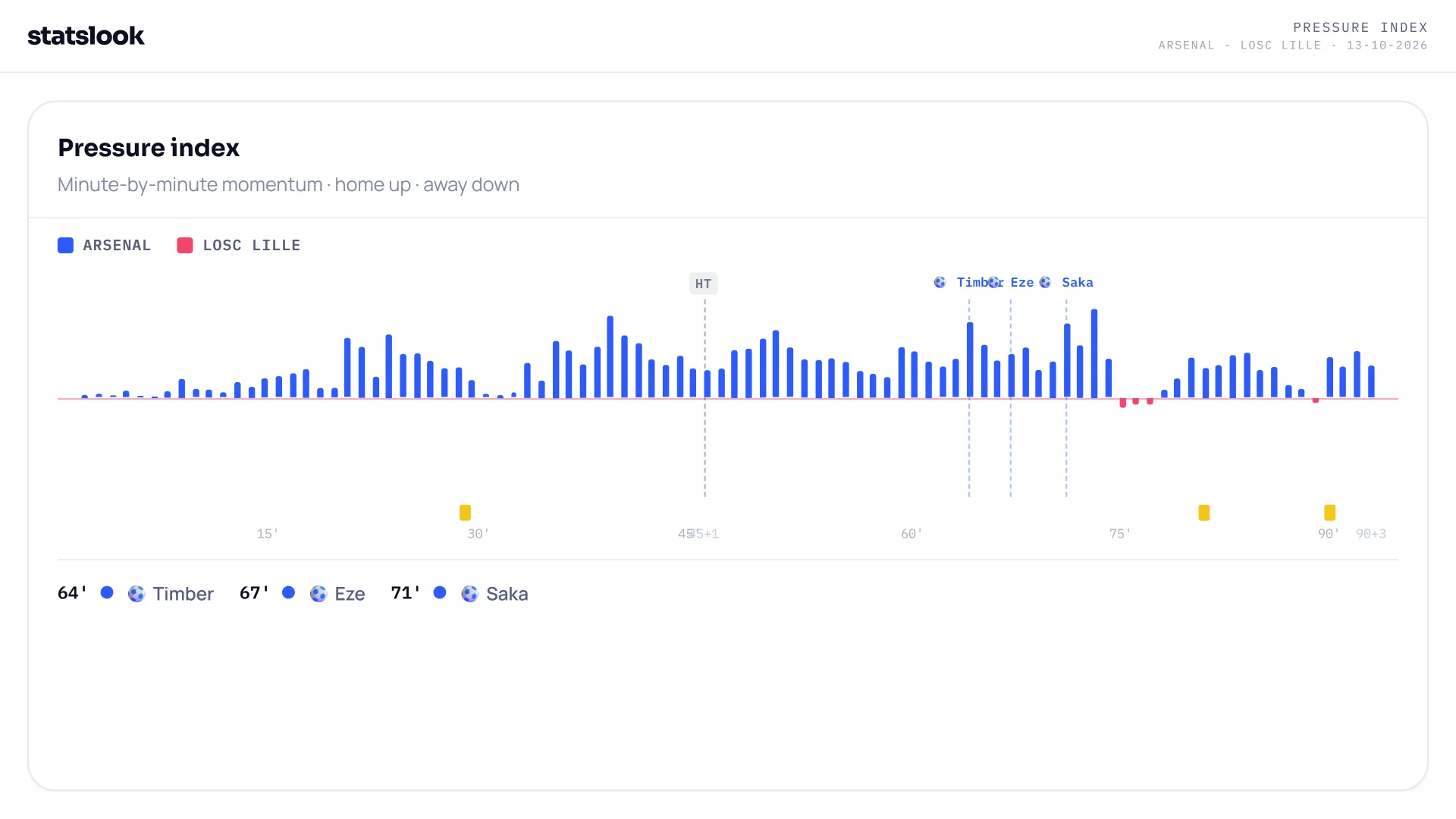
Jurriën Timber opened the scoring in the 64th minute. Eberechi Eze doubled Arsenal's advantage three minutes later, before Bukayo Saka made it 3–0 in the 71st.
The introduction of Saka, Kai Havertz and Martin Ødegaard played an important role in the second-half breakthrough.
However, the underlying numbers tell a broader story.
Arsenal did not suddenly become the dominant team after the substitutions. Their attacking superiority had already been evident for much of the contest.
98–5: The Statistic That Defines Arsenal's Dominance
The most striking difference between the two teams was not the final score.
It was their attacking output.
According to StatsLook, Arsenal registered 132 total attacks, compared with just 44 for Lille.
That represents exactly three times as many attacks.
The gap became even more pronounced in dangerous attacks.
Arsenal recorded 98 dangerous attacks, while Lille managed only five.
That is a remarkable 19.6-to-one ratio.
Dangerous attacks are not equivalent to clear-cut goalscoring opportunities, but they provide an indication of how frequently a team develops threatening attacking situations.
And the contrast was considerable.
Arsenal also outshot Lille 16–4 and won seven corners to the visitors' none.
These statistics describe a match in which Arsenal consistently applied attacking pressure while restricting Lille's ability to advance into threatening positions.
The Pressure Index: Control Before the Breakthrough
A goalless first half does not necessarily indicate an evenly contested match.
StatsLook's Pressure Index demonstrates that distinction clearly.
The report identifies an extended Arsenal pressure window from the opening minutes through the 77th minute.
Across that period, the home side registered 13 shots worth 1.65 xG, including all three goals.
The chart shows Arsenal's attacking pressure developing during the first half and continuing after the interval.
Lille defended resolutely enough to prevent an early breakthrough.
Bruno Guimarães and Mikel Merino had opportunities before half-time, while Lille briefly threatened at the other end when Ayase Ueda found the net, only for the effort to be ruled out for offside.
Despite Arsenal's territorial advantage, the score remained 0–0 at the break.
The important distinction is that Lille's defensive resistance delayed Arsenal's scoring rather than eliminating their attacking threat.
Minutes 64, 67 and 71: The Seven-Minute Blitz
Lille's resistance finally broke in the 64th minute.
Jurriën Timber collected Noni Madueke's pass and lifted his finish beyond goalkeeper Berke Özer to give Arsenal the lead.
Three minutes later, Bukayo Saka, recently introduced from the bench, supplied Eberechi Eze, who finished to double the advantage.
In the 71st minute, Saka became the goalscorer himself.
A flowing move involving Kai Havertz and Martin Ødegaard ended with the England international curling the ball into the net.
Three goals in seven minutes transformed a competitive scoreline into a comfortable victory.
But the timing of those goals should not obscure the broader pattern.
Arsenal had already spent much of the match creating attacking situations. The difference was that those opportunities finally translated into goals.
Arteta's substitutions provided an additional attacking dimension at precisely the moment Arsenal needed greater effectiveness in front of goal.
Bukayo Saka: 25 Minutes, 16 Touches, One Goal
Bukayo Saka's impact was particularly notable.
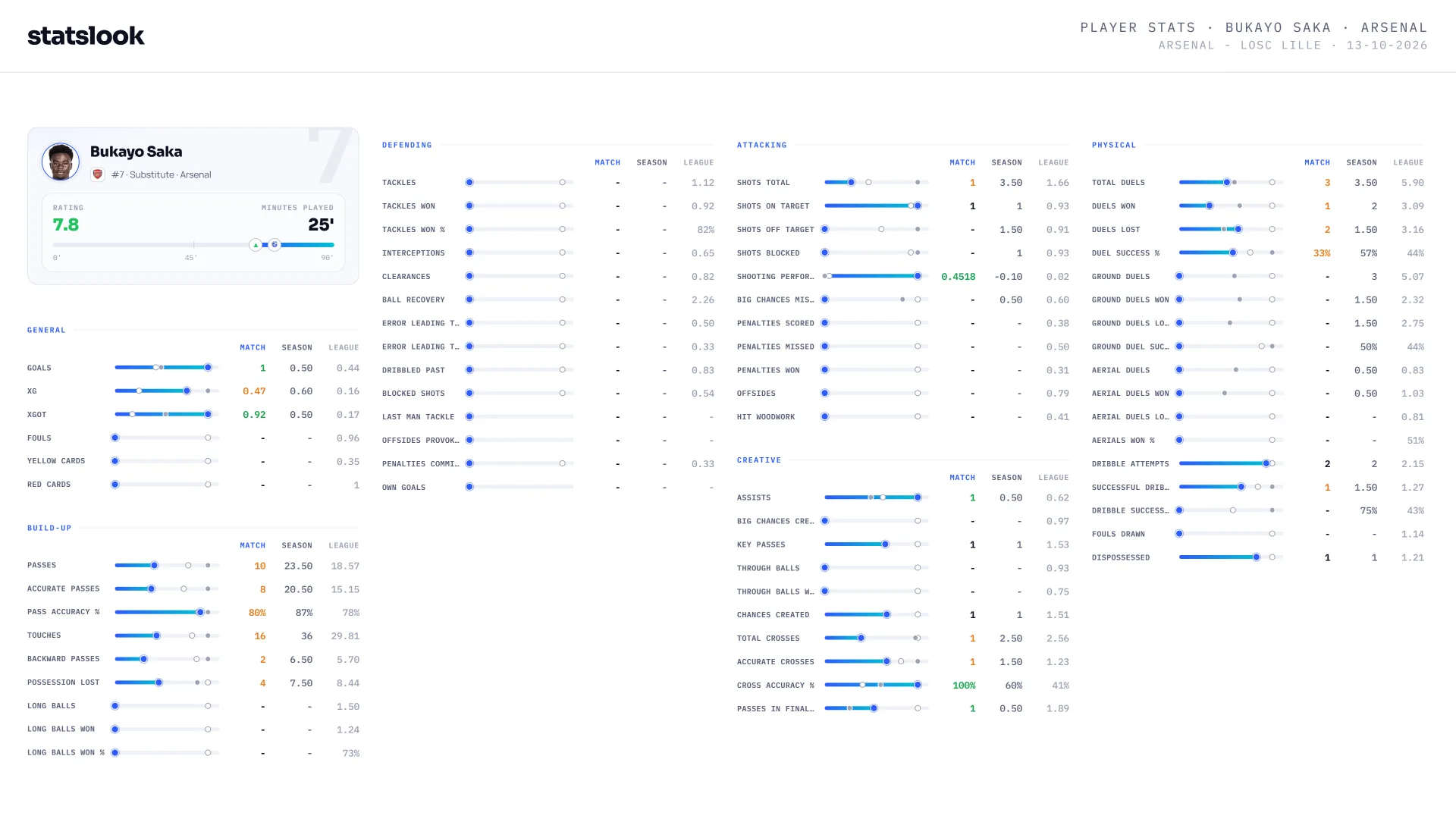
The England international spent just 25 minutes on the pitch and registered only 16 touches.
Yet he scored once and provided the final pass for Eze's goal.
His StatsLook match figures were:
25 minutes played
16 touches
1 goal
1 shot
0.47 expected goals (xG)
0.92 expected goals on target (xGoT)
7.76 performance rating
Saka's single shot accounted for approximately 24% of Arsenal's total 1.95 xG.
Its 0.92 xGoT value also indicates a highly threatening on-target finish.
His impact was therefore not built on a large number of touches or repeated shooting opportunities.
Instead, he made decisive contributions in a limited amount of playing time.
Timber and Guimarães: More Than a Story About Substitutes
While Saka's contribution attracted attention, StatsLook's individual ratings highlight two other outstanding performers.
Jurriën Timber finished with Arsenal's highest performance rating at 8.03.
The Dutch defender played 78 minutes, scored the opening goal and registered two key passes.
He completed 43 of 48 passes, an accuracy rate of approximately 90%, while winning five of his six duels.
Timber combined defensive reliability with an important attacking contribution.
Bruno Guimarães was another standout, earning a 7.99 rating.
The Brazilian midfielder attempted five shots, matching Eze for the highest individual total among Arsenal players.
He also won nine of 14 duels, registered seven tackles and made three interceptions.
His contribution illustrates the influence Arsenal's midfield exerted on the contest.
Eberechi Eze, meanwhile, generated 0.59 xG — the highest individual total in Arsenal's squad.
He attempted five shots and scored the second goal.
Together, these performances show that Arsenal's victory depended on contributions throughout the team, not solely on the substitutes who influenced the final stages.
1.95–0.35 xG: Arsenal Controlled the Quality of Chances
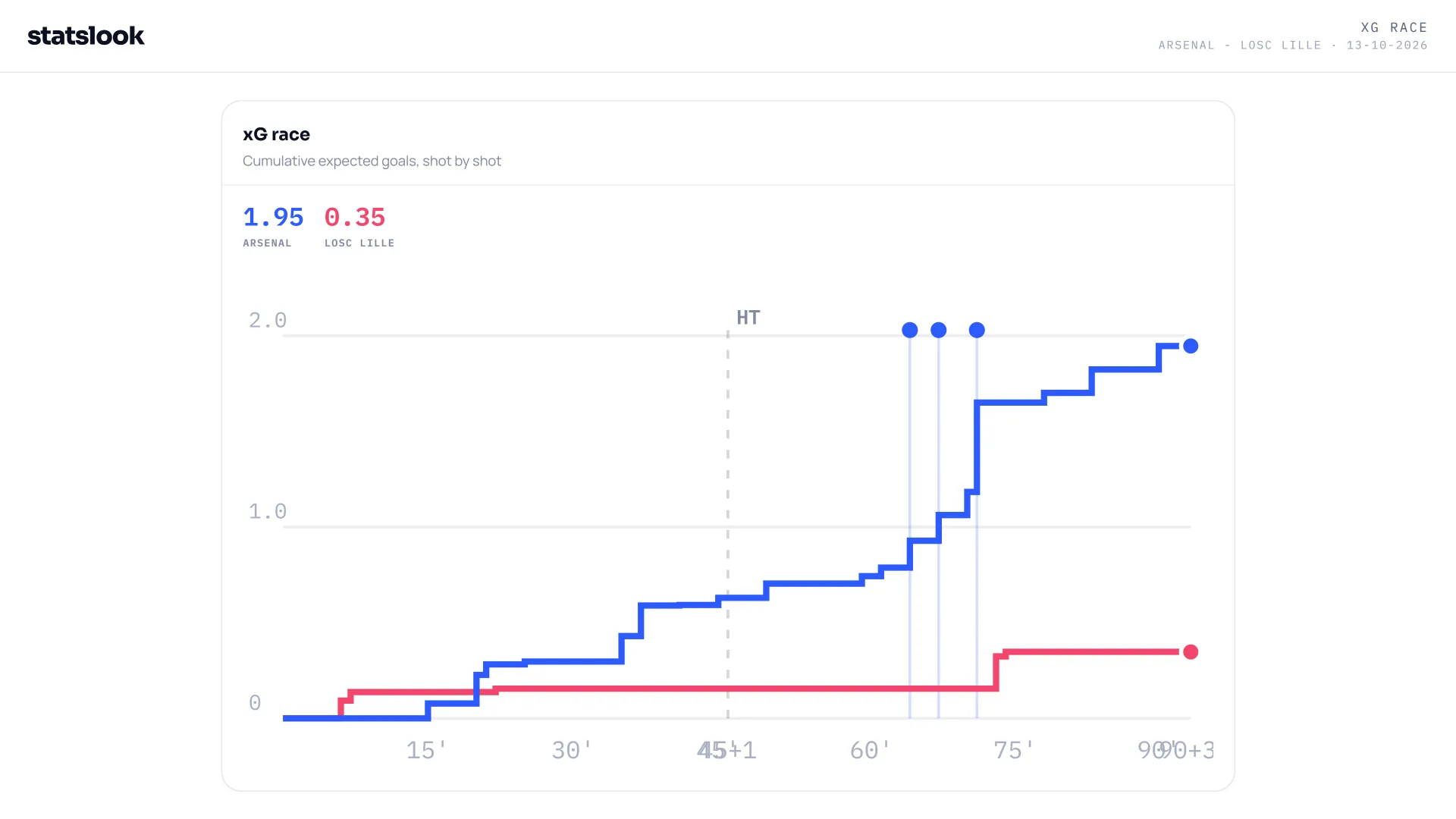
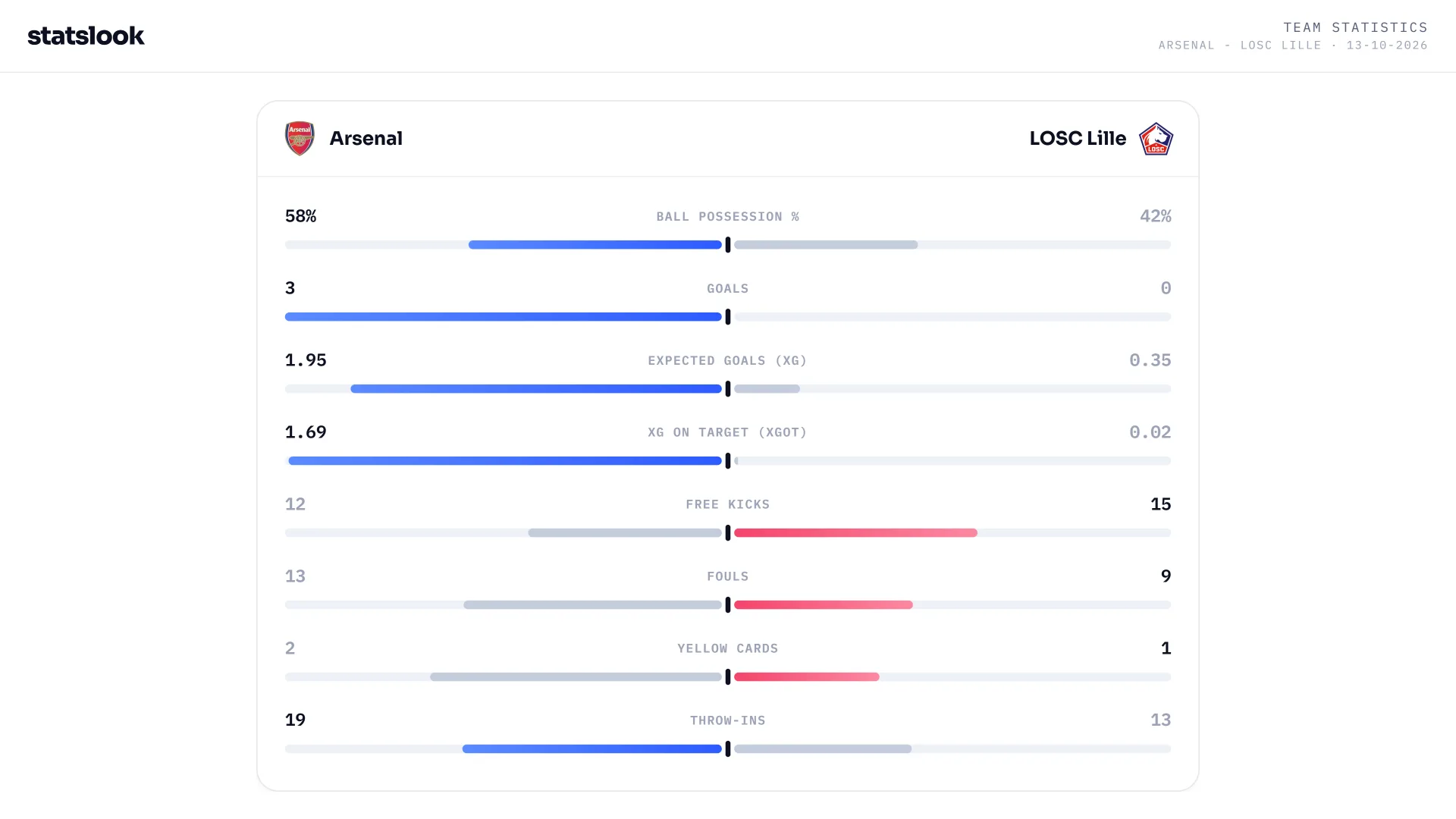
Arsenal finished the match with 1.95 xG, compared with Lille's 0.35 xG, according to StatsLook.
The 1.60 xG difference highlights a substantial gap in the quality and volume of scoring opportunities.
Of Arsenal's 16 shots, 12 came from inside the penalty area.
Those attempts generated 1.75 xG, approximately 90% of Arsenal's total expected goals.
This is significant because it shows that Arsenal's dominance was not simply the result of speculative attempts from distance.
Their attacking play consistently produced shooting opportunities inside the penalty area.
Lille, by contrast, attempted just four shots, only one of which came from inside the box.
Arsenal also held 58% possession and recorded approximately 90% passing accuracy, compared with Lille's 42% possession and 85% passing accuracy.
Combined with the disparity in attacks and dangerous attacks, the xG figures indicate a clear difference between the teams' attacking performances.
Berke Özer: Five Saves Despite Three Goals Conceded
Lille goalkeeper Berke Özer conceded three goals but still earned a 7.12 StatsLook performance rating.
The Turkish international recorded five saves, three from attempts inside the penalty area and two from outside.
His performance was particularly relevant given the amount of defensive pressure Lille faced.
The visitors registered 38 clearances, compared with Arsenal's eight.
That difference reflects how frequently Lille were required to intervene defensively and clear the ball away from danger.
Özer's five saves and Lille's 38 clearances help explain how the visitors remained level for more than an hour despite Arsenal's sustained attacking advantage.
Ultimately, the defensive effort could not prevent Arsenal's rapid sequence of second-half goals.
Final Verdict: The Goals Came in Seven Minutes, the Dominance Lasted Much Longer
Arsenal's 3–0 victory was not simply the result of a sudden second-half surge.
StatsLook's Pressure Index and attacking statistics show that Mikel Arteta's side had already established control before the first goal arrived.
The numbers were emphatic:
Arsenal produced 132 attacks, 98 dangerous attacks and 16 shots, while restricting Lille to 0.35 xG.
Arteta's substitutions then helped convert that superiority into a decisive result.
Saka's goal and assist involvement demonstrated the depth of Arsenal's attacking options, while Timber, Eze and Guimarães made substantial contributions across the match.
Lille resisted for more than an hour, but their defensive work and Berke Özer's saves were ultimately insufficient to withstand Arsenal's pressure.
Arsenal did not establish their dominance in seven minutes. They turned it into goals in seven minutes.
That is the defining story behind their 3–0 Champions League victory.
Data source: StatsLook — Arsenal 3–0 LOSC Lille, UEFA Champions League, 13 October 2026.
Explore match xG, xGoT, Pressure Index and individual player performances with StatsLook.