Fenerbahçe vs Slavia Prague: Unbeaten at Home, Struggling in Europe
Slavia Prague travel to face Fenerbahçe on October 20 with an unbeaten domestic record but two defeats in the Champions League. Despite generating 4.72 xG and 35 shots across their opening two European matches, the Czech side have scored just twice. StatsLook examines their tactical identity, attacking efficiency, defensive vulnerabilities and the key factors that could shape the encounter in Istanbul.
Fenerbahçe vs Slavia Prague: Unbeaten Domestically, Struggling in Europe
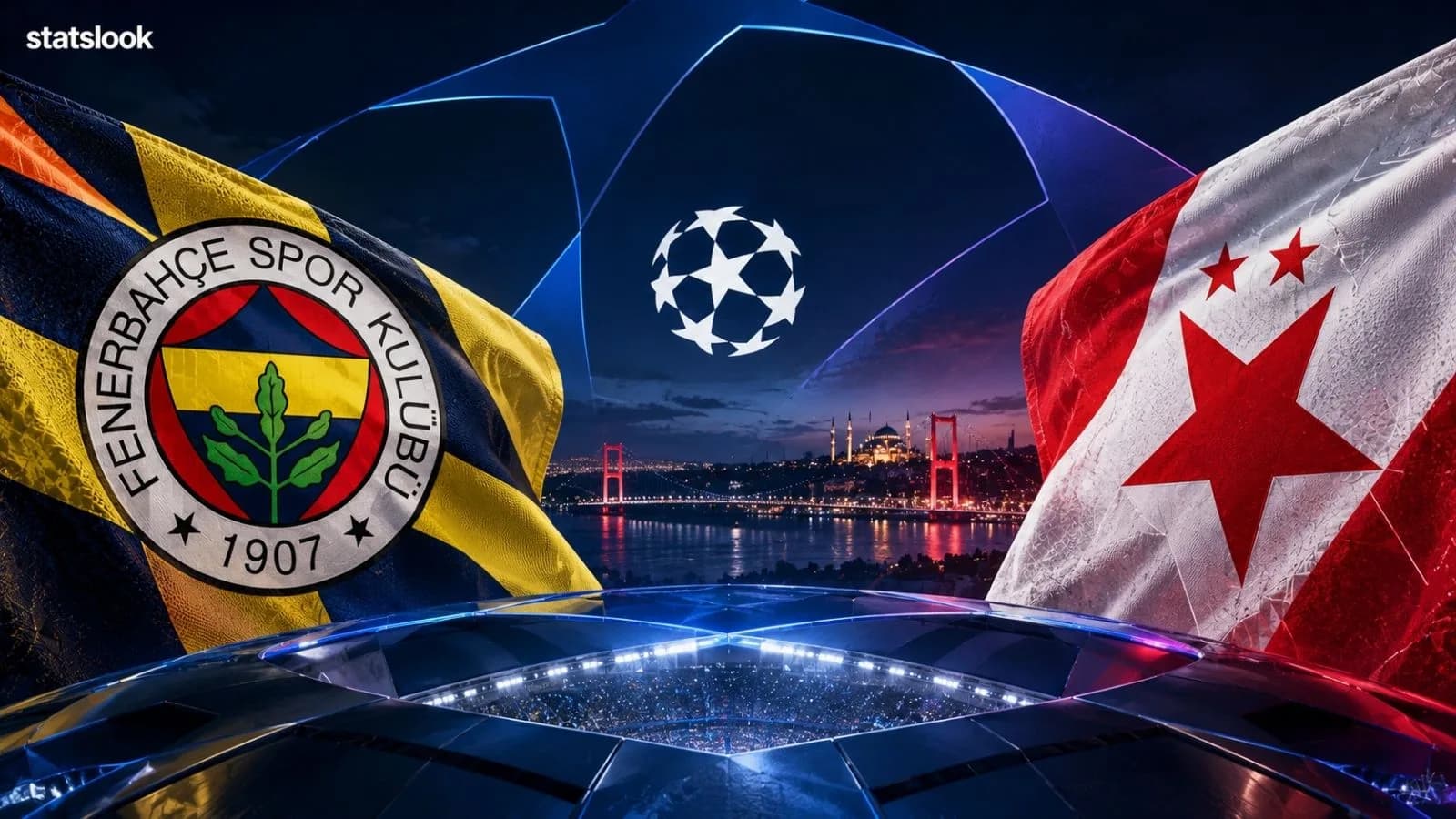
Fenerbahçe host Slavia Prague in the UEFA Champions League on October 20, 2026, facing a Czech side that has dominated domestically but struggled to turn its attacking performances into results in Europe. StatsLook examines Slavia's tactical identity, attacking efficiency, defensive concerns and the key factors that could shape the encounter in Istanbul.
Domestic Dominance: 11 Matches Without Defeat
Under long-serving head coach Jindřich Trpišovský, Slavia Prague have established themselves as one of the Czech league's most consistent and aggressive teams.
Their opening 11 league matches of the 2026/27 season produced eight victories, three draws and no defeats. Slavia scored 26 goals while conceding just six, averaging 2.36 goals per game.
Their attacking numbers illustrate the extent of that domestic dominance.
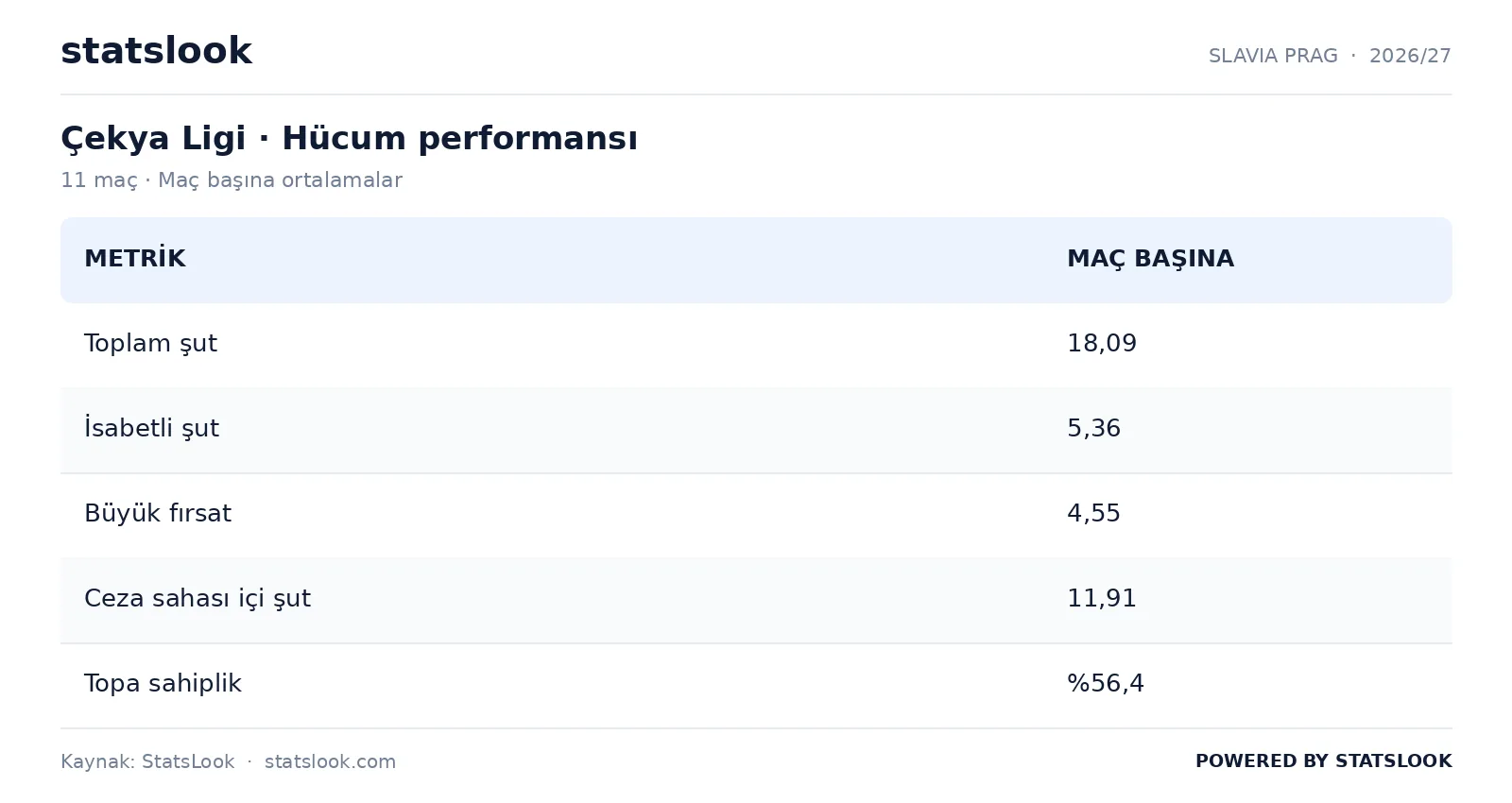
Slavia's attacking identity is built around sustained pressure, collective movement and frequent entries into dangerous areas.
Nearly two-thirds of their shots come from inside the penalty area, demonstrating their ability to advance possession into threatening positions rather than relying exclusively on speculative long-range attempts.
However, their effectiveness is not entirely dependent on controlling possession.
The Sparta Prague Match Reveals Another Dimension
One of Slavia's most revealing performances came in their 3-0 away victory over Sparta Prague.
Despite recording just 29% possession, Slavia produced nine shots, five attempts on target and four big chances.
The result illustrates an important characteristic of Trpišovský's team: they can create meaningful attacking opportunities without dominating the ball.
For Fenerbahçe, this presents a potential tactical challenge.
Allowing Slavia less possession does not automatically eliminate their attacking threat. Their ability to produce chances in matches where they spend extended periods without the ball means Fenerbahçe must remain attentive to transitions and changes of possession.
Nevertheless, one match alone cannot establish Slavia as a predominantly counterattacking side. A more complete assessment requires examining their ball recoveries, attacking sequences and transition opportunities.
Champions League Struggles: 4.72 xG, Just Two Goals
Slavia's domestic success contrasts sharply with their opening Champions League results.
Despite generating a considerable volume of attacking opportunities, the Czech side have suffered two defeats.
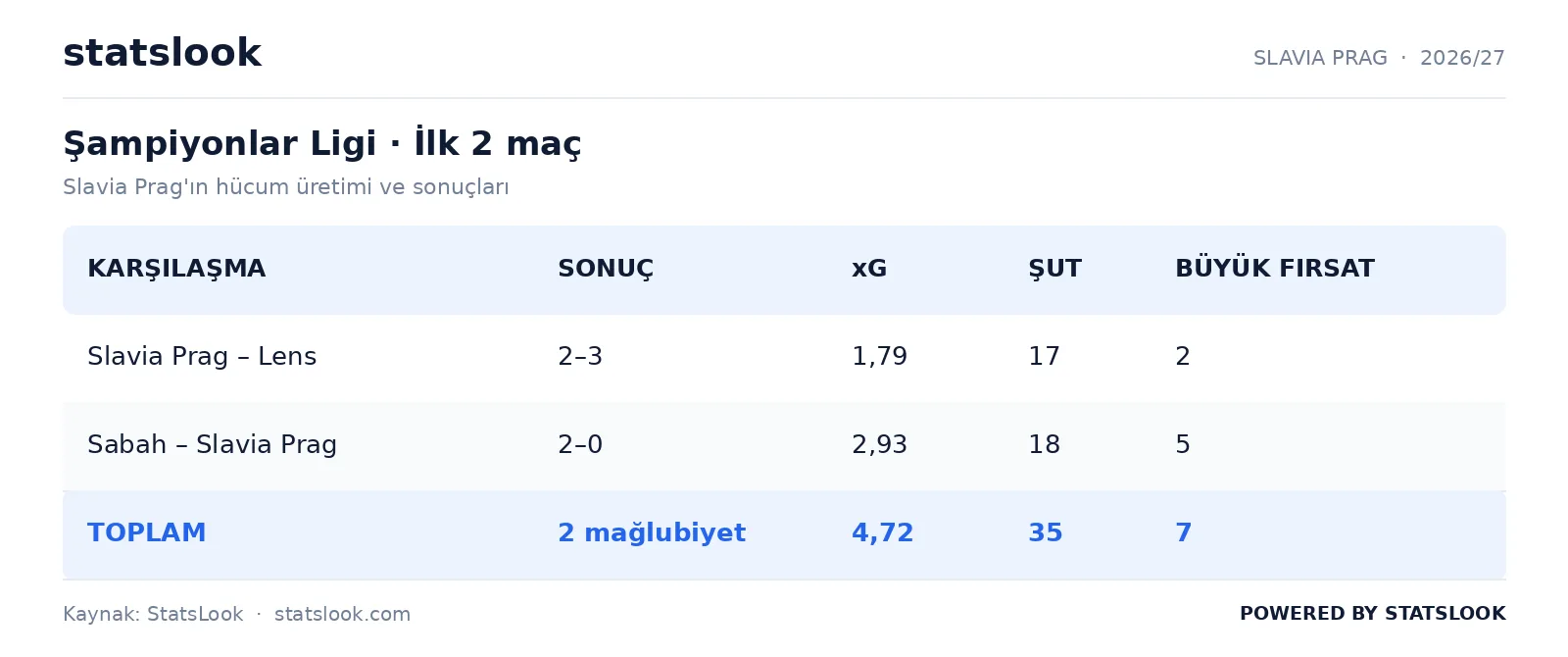
Across those two matches, Slavia registered 35 shots and seven big chances but scored only twice.
Their actual goal output fell 2.72 goals below their expected goals total.
The most striking example came against Sabah.
Slavia generated 2.93 xG from 18 attempts, including eight shots on target and five big chances. Yet they failed to score and suffered a 2-0 defeat.
This is a crucial distinction when evaluating Slavia's European performances.
Their primary attacking concern has not been an inability to create opportunities. It has been their failure to convert those opportunities into goals.
However, a two-match sample remains too small to establish a persistent finishing weakness. The gap between goals and xG could narrow significantly over subsequent fixtures.
Trpišovský's Tactical Philosophy: Intensity, Organisation and Collective Movement
Jindřich Trpišovský has built Slavia's identity around aggressive collective football.
His approach emphasises high intensity, coordinated movement, pressure on opponents and quick reactions after losing possession.
These principles have contributed to Slavia's domestic consistency, but translating them into Champions League results has proved more difficult.
According to the research gathered for this analysis, Trpišovský expressed considerable frustration following the defeat against Sabah.
His reported assessment highlighted excessive turnovers, individual mistakes, insufficient technical quality and poor decision-making.
Another particularly interesting aspect of his reported comments concerned Slavia's relationship with the favourites' role.
The coach suggested that his players can sometimes perform with greater intensity and make quicker decisions against stronger opponents, while struggling to maintain the same standards in matches they are expected to win.
This observation could be relevant to the Fenerbahçe encounter.
Playing away in Istanbul may encourage Slavia to adopt a more selective approach to pressing, accept periods without possession and prioritise efficient attacking transitions.
That remains a tactical possibility rather than a confirmed match plan.
Defensive Concerns: Five Goals Conceded in Two European Matches
Slavia's Champions League difficulties extend beyond finishing.
They conceded three goals against Lens and two against Sabah, leaving them with five goals conceded across their opening two fixtures.
This raises questions about how effectively their defensive structure operates against European opposition.
Trpišovský's aggressive approach depends on coordinated pressure and rapid defensive reactions. When those mechanisms fail, opponents may find opportunities to attack spaces behind the initial pressing line.
However, the five goals conceded do not, by themselves, prove that Slavia consistently leave those spaces exposed.
To establish that weakness, the defensive sequences against Lens and Sabah must be examined in greater detail, particularly the origins of opposition chances, defensive positioning after turnovers and the effectiveness of Slavia's recovery runs.
For Fenerbahçe, the key question is whether Slavia's defensive organisation remains stable when their initial pressure is bypassed.
Attacking Personnel: Different Sources of Threat
Slavia possess several players capable of contributing through different attacking actions.
Wiktor Nowak has featured in 13 matches, accumulating 908 minutes. His averages of 0.38 goals and 2.00 shots per match indicate a midfielder capable of contributing directly to the scoring output.
Emmanuel Ayaosi has played 781 minutes across 12 appearances. His 0.33 goals, 1.58 key passes and 1.33 successful dribbles per match highlight his involvement in both individual attacking actions and chance creation.
Lukas Provod has registered 2.64 shots, 1.45 key passes and 2.73 crosses per match across 11 appearances.
These profiles demonstrate the variety within Slavia's attacking structure.
Nowak contributes scoring threat from midfield, Ayaosi provides individual attacking actions and creative passing, while Provod combines shooting volume with deliveries into advanced areas.
Their contributions should be evaluated in the context of their starting positions and tactical responsibilities rather than treating all three as identical attacking profiles.
Squad Availability: Questions Surrounding Chorý and Other Players
Slavia's preparations have also been affected by personnel concerns.
In their most recent domestic match, a goalless draw against Hradec Králové, Tomáš Chorý received a red card.
Research gathered ahead of the fixture indicates that Trpišovský subsequently stated Chorý would not travel to Istanbul. This reported decision requires confirmation from an official or attributable source before publication as a definitive squad update.
Chorý's potential absence would be relevant to Slavia's attacking options.
The striker has averaged 2.20 aerial duels won per match, offering a physical presence in attacking situations.
There are also reported fitness concerns involving David Jurásek and Ivan Schranz.
Their availability should be assessed against official squad information before the match.
Three Tactical Areas That Could Shape Fenerbahçe vs Slavia Prague
1. Managing Slavia's Shot Volume
Slavia average more than 18 shots per match in domestic competition.
Their ability to generate frequent attempts, including a substantial number from inside the penalty area, makes limiting the quality of their shooting opportunities a significant consideration.
For Fenerbahçe, the most informative measure will not simply be how many shots Slavia take, but where those attempts originate and how dangerous they are.
A high shot count with limited xG can tell a very different story from fewer attempts generated in high-value scoring positions.
2. Attacking Against Slavia's Defensive Pressure
Slavia's collective pressing and high-intensity approach could influence Fenerbahçe's ability to progress the ball through midfield.
The effectiveness of Fenerbahçe's initial passing sequences and their ability to progress beyond Slavia's first defensive line will be important areas to observe.
If Slavia commit players forward during pressing phases, the positioning of their remaining defenders and midfield cover could become particularly relevant.
However, whether this creates exploitable space depends on the actual structure of Slavia's press and Fenerbahçe's personnel.
3. The Battle for Control Without the Ball
Slavia's 3-0 victory over Sparta Prague demonstrated that they can remain dangerous with limited possession.
This makes the Fenerbahçe match more complex than a straightforward contest between a possession-oriented home team and a defensive visitor.
Slavia may be comfortable operating through different phases of play.
The timing of turnovers, the positioning of players during attacking transitions and the quality of defensive recovery could therefore be as important as overall possession percentages.
Does Slavia's European Record Create Additional Pressure?
Slavia's difficulties in the Champions League have attracted attention beyond their opening two matches of the current campaign.
Research supplied for this report refers to a longer winless sequence in the competition's league-stage format, reportedly extending to 21 matches across multiple seasons.
That historical figure should be independently verified before being presented as an established record.
Even without relying on the longer sequence, the current campaign already presents a clear contrast.
Slavia are unbeaten in their domestic league but have lost both European fixtures despite creating several high-quality chances.
Whether this reflects technical limitations, finishing variance, opposition quality or psychological pressure cannot be determined from the results alone.
Trpišovský's reported comments about decision-making and the favourites' role nevertheless provide useful context for interpreting the difference between Slavia's domestic and European performances.
Conclusion: Fenerbahçe Face a Team Whose Results Do Not Tell the Full Story
Slavia Prague arrive in Istanbul with a distinctive statistical profile.
Their unbeaten domestic run demonstrates consistency, while their attacking figures reveal a team capable of producing considerable shot volume and frequent scoring opportunities.
Their Champions League record tells a different story.
Two defeats, five goals conceded and only two goals scored from 4.72 xG suggest a significant gap between attacking production and results.
For Fenerbahçe, overlooking Slavia's attacking potential because of those defeats would be misleading.
The Czech side have shown that they can create opportunities both while controlling possession and when playing with considerably less of the ball.
The defining question is not simply whether Slavia can threaten Fenerbahçe. Their existing performances suggest they can. The more important issue is whether they can convert their attacking opportunities while maintaining sufficient defensive stability against Champions League opposition.
The October 20 encounter offers another test of whether Slavia's established domestic identity can translate into effective European football.
Explore the Match on StatsLook
Fenerbahçe vs Slavia Praha — Match Centre
Access match information, team statistics and simulation tools.
Explore Fenerbahçe's 2026/27 season performance, squad and statistical profile.
Review Slavia's fixtures, squad statistics and season performance.
Data source: StatsLook, 2026/27 season. Statistical analysis is based on the 11 domestic league matches and two Champions League matches supplied for this report. Reported coaching comments, historical records and squad availability information require independent confirmation before publication.