Aleksey Batrakov Scout Report: Elite Output From a Hybrid No.10
Aleksey Batrakov has produced 27 goals and 16 assists across two seasons for Lokomotiv Moscow. His StatsLook profile highlights a versatile attacking midfielder with elite shooting, chance creation and final-third involvement.
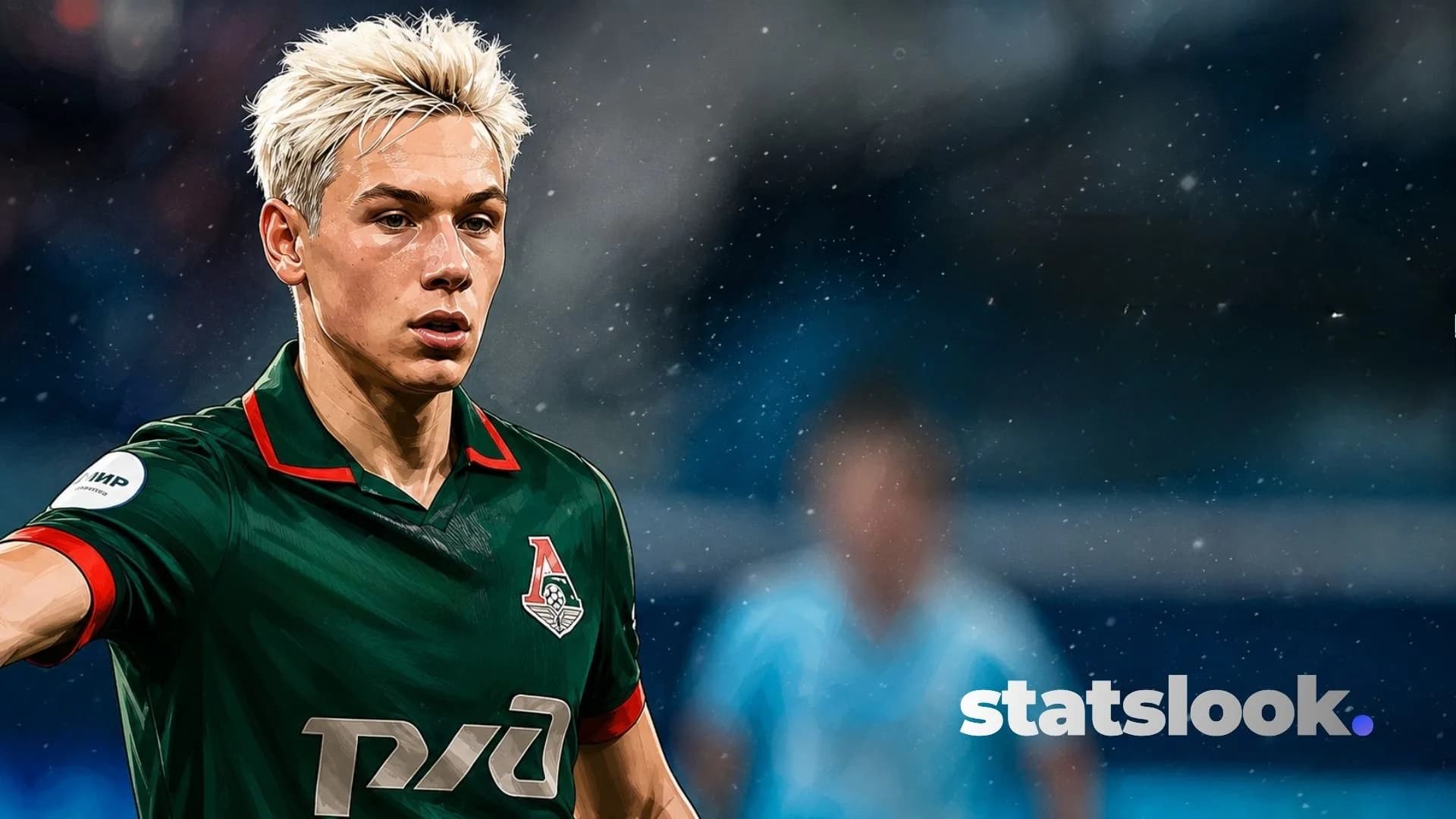
Aleksey Batrakov: A Playmaker Who Starts and Finishes Attacks
Aleksey Batrakov’s production across the past two seasons makes him one of the most distinctive young attacking midfielders in the supplied StatsLook data.
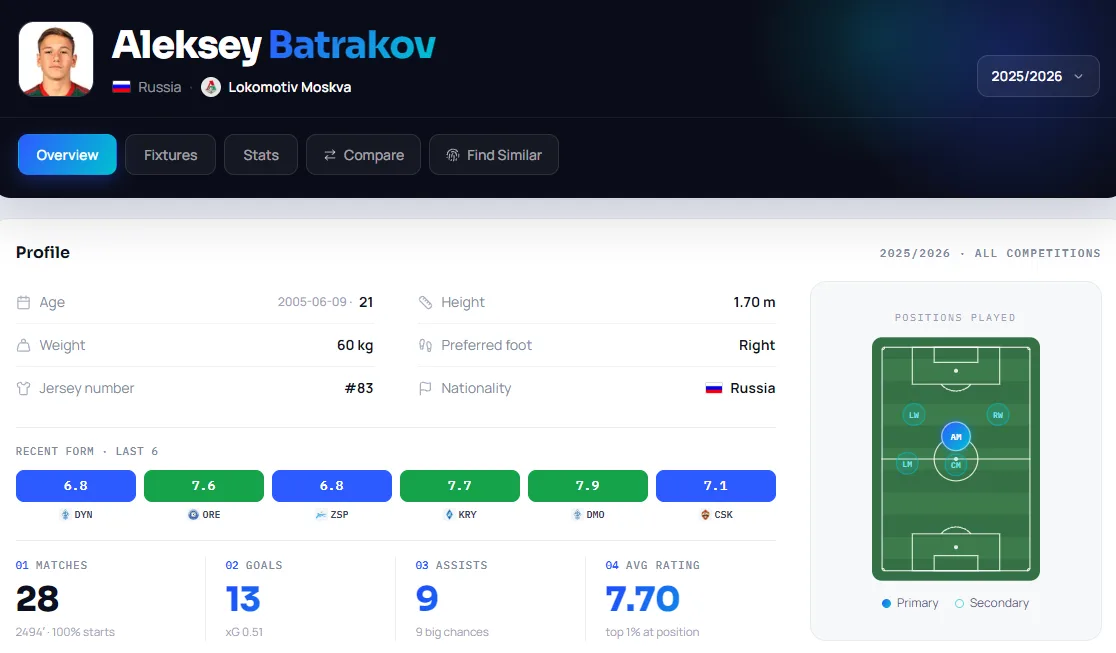
The 21-year-old recorded 27 goals and 16 assists across 57 appearances for Lokomotiv Moscow in 2024/25 and 2025/26. He finished both campaigns with an average rating of 7.70 and started every match included in the data.
His tactical responsibilities expanded significantly during the second season. After operating primarily as a No.10 in 2024/25, Batrakov was also used in central midfield, on both wings and as a left midfielder in 2025/26.
The resulting profile is not that of a traditional playmaker who simply supplies the forwards. Batrakov is a goal-oriented creator who can both construct and complete attacking moves.
Consistent Production Across Two Seasons
Batrakov’s headline output remained remarkably stable:
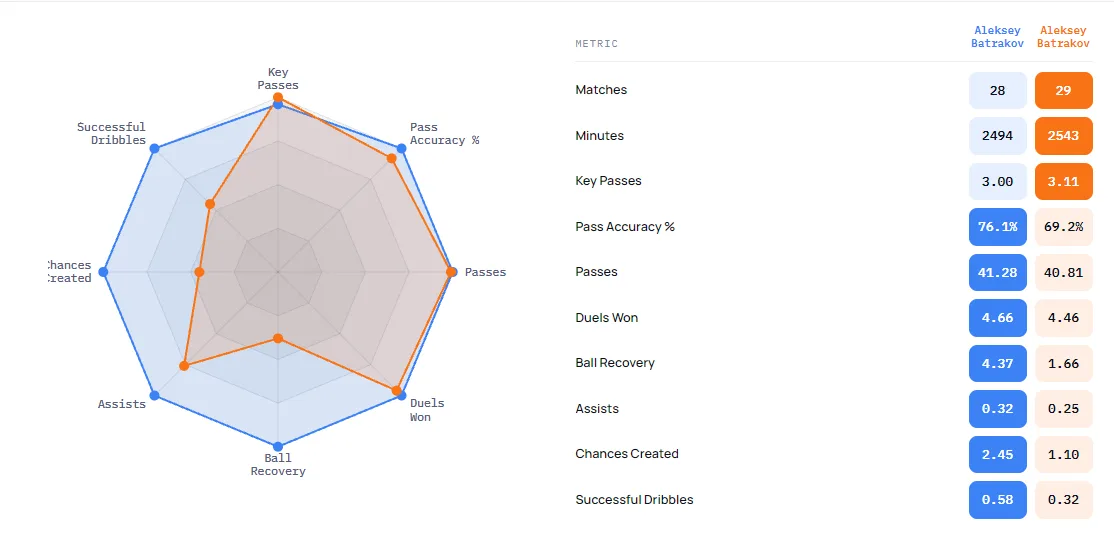
2024/25
29 matches
2,543 minutes
14 goals
7 assists
7.70 average rating
2025/26
28 matches
2,494 minutes
13 goals
9 assists
7.70 average rating
His goal total fell by only one, while his assists increased from seven to nine.
That gave him 21 direct goal contributions in 2024/25 and 22 in 2025/26. The consistency is significant because his production did not decline noticeably after opponents had gained more information about his movement and attacking habits.
Playing Style: A Free-Roaming Central No.10
Batrakov’s most natural role is as the central attacking midfielder in a 4-2-3-1.
His game is built around freedom of movement rather than occupying one fixed position. He drifts between midfield and defence, moves into both half-spaces and generally looks to receive while facing the opposition goal.
Once in possession, he can increase the speed of an attack. He does not always attempt to beat his opponent directly. At times, he draws or pins a defender before releasing the ball and creating space for a teammate.
He is particularly effective in tight areas through quick combinations, lay-offs and short passing sequences.
Although he is capable of playing longer balls, his game is primarily based on ground passes and close-range combinations. His lay-offs into the striker, followed by immediate forward movement, allow him to remain involved in the second phase of the same attack.
His Defining Strength: Arriving in the Box at the Right Time
Batrakov’s goals are not primarily created through raw pace or physical domination.
His main advantage is his ability to read the defensive line and recognise when space is about to appear inside the penalty area.
According to the additional scouting information provided, 20 of his last 25 goals came from inside the box. That distribution reflects a midfielder who does not depend on repeated low-percentage shots from long range.
Batrakov often waits for the striker to occupy the centre-backs. Once a gap appears between defenders or behind the midfield line, he makes a late but decisive run into the area.
This timing allows him to reach scoring positions without constantly becoming involved in physical contact. Rather than overpowering defenders, he uses movement to step outside their field of vision and arrive as a second-wave threat.
This is why his profile combines playmaking technique with forward-like instincts.
Unusual Goal Threat for a No.10
Batrakov’s most obvious statistical strength is his scoring output.
In the supplied StatsLook comparison against Premier League attacking midfielders, his 2025/26 production per 90 ranked:
Goals scored: #1 — 0.47
Total shots: #1 — 2.63
Shots on target: #1 — 1.19
He also ranked first for goals per 90 in 2024/25, when he averaged 0.50.
This is not the profile of a midfielder who remains outside the penalty area and only looks for the final pass. Batrakov also takes responsibility for finishing attacks.
His total shot volume increased from 1.59 to 2.63 per 90, while his shots on target rose from 1.03 to 1.19.
That development points towards a player who became more assertive in the final third and more willing to position himself as a scorer.
Finishing: Composure and Positioning Over Power
Batrakov’s finishing is built more around control than force.
After making a well-timed run into the box, he generally does not rush the final action. He has the composure to assess the goalkeeper’s position and the angle of the nearest defender before shooting.
He can score from distance, but his game is not dominated by speculative attempts. His primary scoring route is to move into the penalty area and find a cleaner shooting angle.
That approach allows him to produce goals without constantly engaging in direct physical battles.
His finishing profile is therefore closely connected to his football intelligence. The quality of the movement often gives him the extra time required to finish calmly.
An Important Warning About the xG Data
There is an unusually large gap between Batrakov’s goals and the supplied expected-goals figures:
2024/25: 14 goals from 2.09 xG
2025/26: 13 goals from 0.51 xG
Taken literally, those numbers would suggest finishing at an extraordinary level above expectation.
However, the difference is so extreme that the xG data may be incomplete or limited to certain events within the available coverage.
Without shot-location data and detailed event information, it would be unsafe to describe Batrakov simply as an historically clinical finisher.
His goal and shot production are clearly strong. The exact sustainability of his conversion rate requires further verification.
A Creator as Well as a Scorer
Batrakov’s scoring threat does not reduce his creative contribution.
He averaged:
3.11 key passes per 90 in 2024/25
3.00 key passes per 90 in 2025/26
Those figures ranked second and third respectively in the supplied positional comparison.
His assist rate also increased from 0.25 to 0.32 per 90, placing him fourth among the attacking midfielders in the 2025/26 benchmark.
Batrakov is therefore not simply an advanced midfielder who shoots frequently. He creates at a level that could allow him to function as one of his team’s main attacking connectors.
His most effective role is one in which he does not stop after playing the final pass. He can continue the move, receive a return ball or attack the penalty area.
Football Intelligence and Spatial Awareness
One of Batrakov’s strongest qualities is his ability to anticipate where space will open before the move fully develops.
He reads the direction of the opposing midfield, whether a centre-back has followed the striker and how much distance exists between the full-back and central defender.
That allows him to identify useful progression angles without relying on superior speed.
When he receives the ball, he is not automatically committed to the first available option. He can assess whether to pass, carry or shoot depending on the movement around him.
This is especially valuable against compact defensive blocks. When physical strength cannot create separation, he can disrupt the structure through positioning and timing.
Former player Aleksey Gasilin has used the expression “golden foot” to describe Batrakov, highlighting the appeal and technical quality of his attacking football.
Technical Profile: Clean and Balanced in Tight Spaces
Batrakov is not a natural one-versus-one winger, but his close control and balance allow him to find solutions under pressure.
His first touch is generally close and prepared for the next action. He can change direction without pushing the ball too far away and maintains rhythm in short passing combinations.
His technical strengths include:
Close control
Tight-space combinations
Lay-offs and wall passes
Key-pass production
Delivery into the penalty area
Set-piece execution
Controlled finishing
Long-range shooting
Direct free-kick threat
Ball retention is also an important part of his attacking value.
Despite his light frame, his agility, low centre of gravity and ability to place his body between the opponent and the ball allow him to survive short periods of pressure.
High Crossing Volume and Set-Piece Threat
Batrakov averaged 6.50 crosses per 90 in 2025/26 after recording 6.30 the previous season.
Those figures ranked second and third in the respective comparison groups.
His appearances at left wing, right wing and left midfield during 2025/26 partly explain the high volume.
The additional scouting assessment also identifies set pieces, long shots and direct free kicks as important parts of his technical profile.
The StatsLook data does not separate open-play crosses from set-piece deliveries, so the exact source of the 6.50-cross figure cannot be established.
What is clear is that Batrakov can provide regular service into the penalty area from both wide areas and dead-ball situations.
More of a Half-Space Playmaker Than a Dribbling Winger
Although Batrakov has played on both flanks, his dribbling output does not define him as a classic winger.
He averaged:
0.32 successful dribbles per 90 in 2024/25
0.58 successful dribbles per 90 in 2025/26
The improvement is positive, but those figures do not describe a player whose main strength is repeatedly isolating and beating full-backs.
His wide role should therefore be understood differently.
Batrakov is better suited to moving inside, linking with central midfielders and creating or shooting from the half-spaces.
He is closer to an inverted playmaker or a wide-starting attacking midfielder than a traditional touchline winger.
Clear Improvement in Passing Security
Batrakov’s 2025/26 possession numbers included:
62.50 touches per 90
31.40 accurate passes
76.1% pass accuracy
His completion rate rose significantly from 69.2% in 2024/25.
That development is notable because it occurred while his positional responsibilities became more varied and his shooting volume increased.
However, 76.1% still does not describe a conservative midfielder who avoids risk.
Batrakov attempts decisive passes, crosses and key actions. A certain level of possession loss should be expected from a player carrying such a high creative burden.
Improvement Without the Ball
One of the most significant changes between the two seasons came in his ball-recovery numbers.
Batrakov improved from 1.66 recoveries per 90 in 2024/25 to 4.37 in 2025/26.
His other defensive figures from the latest season were:
4.66 duels won
1.26 tackles
0.58 interceptions
1.23 aerial duels won
These figures do not make him a defensive midfielder, but they show that he can contribute after possession is lost and take greater responsibility for second balls.
Despite his height, he is not completely ineffective in the air. His timing and positioning allow him to win more aerial duels than his physical profile might initially suggest.
Batrakov can contribute within pressing and counter-pressing structures, but he should not be treated as the team’s primary ball-winner.
Best Role: A Free No.10
Batrakov’s most natural role remains as a No.10 with freedom to move across the attacking line.
In that position, he can:
Receive between midfield and defence
Drift into either half-space
Deliver from wide areas
Create chances through key passes
Make late runs into the box
Finish attacks himself
Combine with the striker
Lead the first press after possession is lost
A rigid positional role could reduce some of his value.
His versatility should be used to give him freedom within the attack rather than simply moving him between different fixed positions from match to match.
How He Fits in a 4-2-3-1
A 4-2-3-1 may provide the clearest structure for Batrakov’s qualities.
Playing behind the striker, he would have two deeper midfielders providing defensive stability and first-phase progression.
That would allow him to focus on receiving in advanced areas and influencing the final action.
The striker ahead of him should ideally be able to:
Occupy the centre-backs
Play with his back to goal
Participate in short combinations
Create space for Batrakov’s late runs
The wingers should provide width and one-versus-one threat. That would allow Batrakov to remain closer to the centre instead of carrying the entire responsibility for stretching the attack.
How He Fits as an Attacking No.8
Batrakov could also operate as an attacking No.8 in a 4-3-3.
In this structure, he would need a disciplined holding midfielder behind him and a more balanced central midfielder on the opposite side.
He could move from central midfield into either half-space and gain freedom around the penalty area.
However, this role would increase his defensive responsibilities.
The team would require a strong rest-defence structure to protect the spaces he leaves when advancing.
Physical Development
Batrakov is listed at 1.70 metres and 60 kilograms in the StatsLook profile.
His agility, balance and low centre of gravity help him compensate for his limited size at his current level. However, he can still be disadvantaged in direct shoulder-to-shoulder duels against stronger opponents.
A move to a faster and more physically demanding European league could require further lower-body strength and greater resistance to contact.
The critical challenge is strengthening without losing mobility.
Batrakov’s value is closely connected to his agility, changes of direction and timed movements into the penalty area. Excessive physical development could negatively affect the movement that makes him distinctive.
Passing Range and Decision Speed
Batrakov is effective in short passing combinations, lay-offs and compact attacking sequences.
There is still room for development in longer line-breaking passes and switches of play.
In some transitions, he carries the ball for too long rather than releasing it early. That can slow the attack and allow the opposition to recover its shape.
Improving the range of his distribution and recognising more quickly when to carry or release the ball would make him a more complete attacking midfielder.
That development could move him from being a highly productive No.10 to a player who can also control the overall tempo of attacks.
Strengths
Goal production: Twenty-seven goals across two seasons from an attacking-midfield starting position.
Penalty-area timing: He beats the defensive line through movement and spatial awareness rather than raw pace.
Chance creation: Approximately three key passes per 90 across consecutive campaigns.
Shot volume: First in both total shots and shots on target in the supplied 2025/26 comparison.
Ball retention: His agility and clean first touch help him remain connected under pressure.
Set-piece quality: He offers crossing, long-range shooting and direct free-kick threat.
Positional versatility: He can operate at AM, CM, LW, RW and LM.
Consistency: Consecutive 7.70 average ratings and more than 20 direct goal contributions in both seasons.
Counter-pressing contribution: His recovery output improved significantly in 2025/26.
Development Areas
Physical duels: Stronger opponents can expose his limitations in direct contact.
One-versus-one dribbling: His output remains modest for a player who has been used in wide positions.
Long-range passing: He can improve his switches of play and longer line-breaking deliveries.
Decision speed: He can occasionally carry the ball for too long during transitions.
Defensive reliability: He can press and recover possession but should not be used as a holding midfielder.
League translation: His production must be assessed carefully before projecting it into a stronger and more physical competition.
Finishing sustainability: The major gap between his goals and the supplied xG figures requires deeper analysis.
Potential and Player Comparisons
Batrakov’s profile has similarities with young European playmakers who both create and finish attacks.
Comparisons with Florian Wirtz, Xavi Simons and Nico Paz should not be interpreted as claims that they are identical players.
The similarities are found in their movement between the lines, their willingness to enter the penalty area and their ability to combine playmaking responsibility with direct goal threat.
Some scouting assessments have also identified Kevin De Bruyne-like elements in Batrakov’s game.
Again, the comparison concerns specific characteristics rather than current performance level: ambitious delivery, set-piece quality, key passing and second-wave attacking runs.
To reach a higher level, Batrakov will need to improve his physical adaptation, passing range and ability to control the tempo of matches.
Progress in those areas could allow him to become more than a productive No.10. He could develop into a multidimensional attacking midfielder capable of filling several roles for a leading European side.
Cross-League Comparison Note
The StatsLook percentile profile compares Batrakov’s Lokomotiv Moscow production with Premier League attacking midfielders.
This is useful for understanding the shape and volume of his output, but it does not mean he would automatically rank first in the Premier League itself.
League strength, defensive intensity, possession share and tactical environment can all have a major effect on production.
The data shows that Batrakov has an unusually productive profile. It does not remove the need to assess how effectively that production would translate to a stronger competition.
Scout Verdict
Aleksey Batrakov is a high-output attacking midfielder who combines goals, chance creation, spatial intelligence and positional flexibility.
He is not a conventional dribbling winger. He is also not a No.10 who only distributes possession.
His game is more direct.
He receives between the lines, accelerates attacks through quick combinations, delivers from wider positions and, most importantly, arrives in the penalty area at the right moment to complete moves.
His total of 43 direct goal contributions across two seasons demonstrates the effectiveness of that hybrid role.
His best position is as a free No.10, although he can also operate as an attacking No.8 or an inverted playmaking winger.
The main scouting question is not whether Batrakov can produce. His two-season record already provides a strong answer.
The more important questions concern how his physical profile, passing range and unusually large goal-to-xG gap would translate into a faster and more physically demanding league.
StatsLook Scout Profile:
Goal-oriented playmaker | Free No.10 | Late box arrivals | Key-pass production | Set-piece threat | Secondary striker movement