Antonio Conte to Manchester United? StatsLook Reveals Carrick's Bigger Problem
Manchester United are taking more shots and producing higher xG, yet collecting fewer points. StatsLook compares two Premier League seasons as Antonio Conte rumours intensify.

Manchester United have increased their shots, expected goals and chance creation in 2026/27, yet their points-per-game average has fallen sharply. As Antonio Conte is linked with the Old Trafford job, StatsLook examines what the underlying numbers reveal about Michael Carrick's struggling side.
Antonio Conte links intensify as Manchester United struggle
Manchester United's difficult opening to the 2026/27 Premier League season has intensified scrutiny of head coach Michael Carrick.
Italian media reports have linked former Chelsea, Inter, Tottenham and Napoli manager Antonio Conte with a potential move to Old Trafford. According to reports cited by TEAMtalk, United are considering their managerial options, while Conte is reportedly open to returning to English football.
However, no completed agreement or managerial change has been officially confirmed.
The speculation follows a disappointing run of Premier League results. United's 1-1 draw against Tottenham on October 10 further increased the pressure, leaving Carrick facing questions about his team's ability to turn performances into victories.
But is United's biggest problem a lack of attacking production?
StatsLook's 2025/26 and 2026/27 Premier League team data suggests a more complicated picture.
Manchester United are creating more chances — but winning fewer points
Comparing United's full 2025/26 campaign with the opening seven matches of 2026/27 reveals a striking contrast.
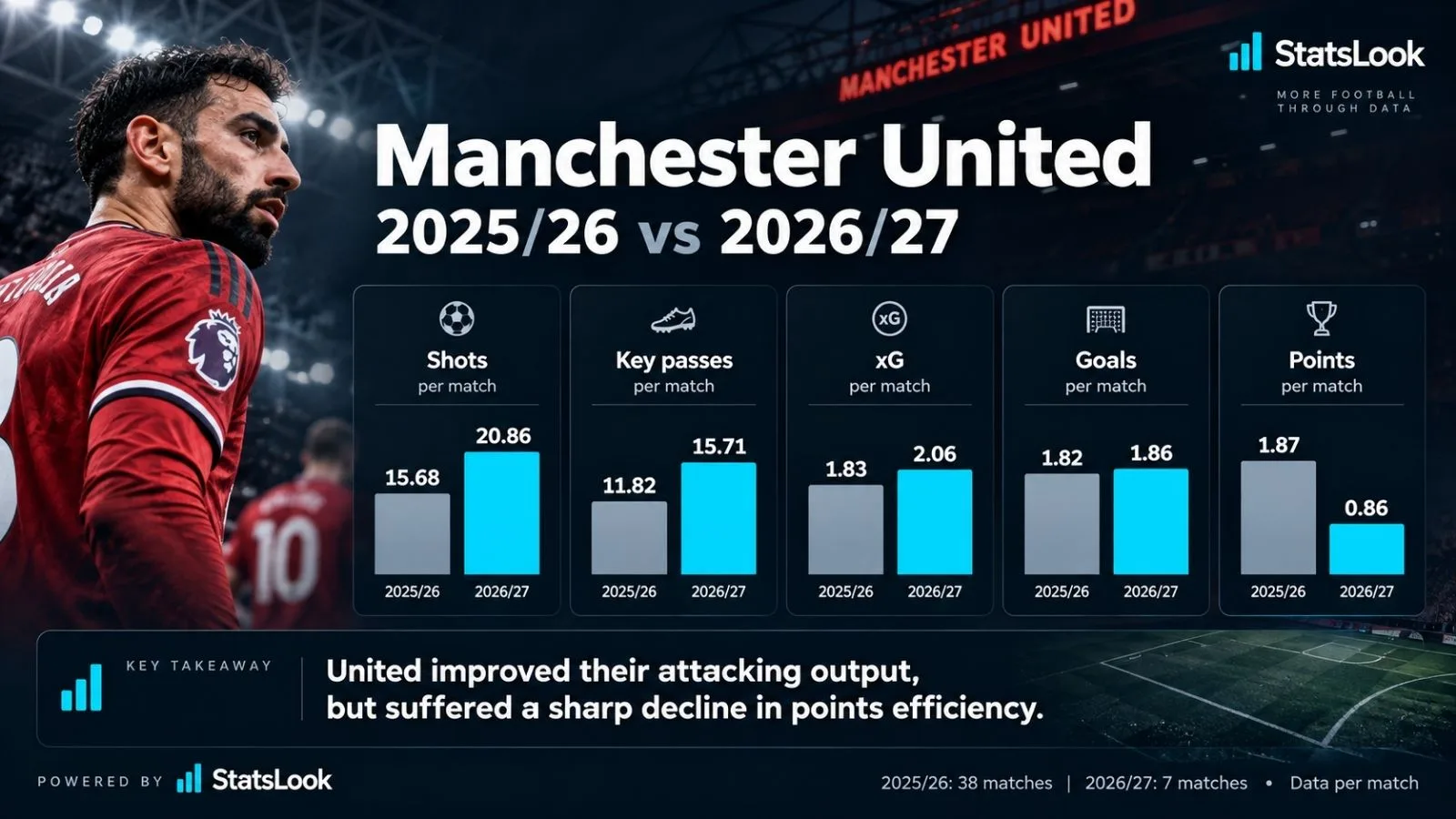
Source: StatsLook Team Scout, Premier League 2025/26 and 2026/27. Current-season figures cover seven matches.
United are averaging approximately 33% more shots and 33% more key passes than last season.
Their expected goals have increased by approximately 13%, while possession has risen by 6.5 percentage points.
Yet points per match have fallen from 1.87 to 0.86 — a decline of approximately 54%.
The central contradiction is clear: United are recording stronger attacking production numbers without achieving stronger results.
These figures do not establish that the team's overall performances have improved. Defensive structure, opposition quality and match circumstances also influence results.
More shots, almost the same number of goals
Manchester United averaged 15.68 shots and 1.83 expected goals per match during 2025/26.
Across the first seven Premier League matches of 2026/27, those figures have risen to 20.86 shots and 2.06 xG.
That represents an additional 5.18 shots per match, but only 0.23 additional expected goals.
The relatively modest increase in xG compared with shot volume suggests that the average expected value of each attempt has declined.
Using the available averages:
2025/26: approximately 0.117 xG per shot.
2026/27: approximately 0.099 xG per shot.
This is a derived measure calculated from the season-level averages, rather than a separate StatsLook metric.
It suggests that United are attempting more shots, but the additional volume has not translated into a proportional increase in expected chance quality.
The goals column reinforces the distinction.
Despite the increased attacking activity, United's goals-per-match average has moved only slightly, from 1.82 to 1.86.
More shots are not automatically producing more goals.
Carrick's side are controlling more possession
United's possession has risen from 51.79% to 58.29%, while pass accuracy has increased from 82.37% to 88.00%.
Key passes have also increased from 11.82 to 15.71 per match.
Taken together, these numbers indicate that United are spending more time on the ball and generating more opportunities for teammates to shoot.
However, possession does not necessarily demonstrate control of a match.
A team may accumulate possession while chasing a result, while opponents may deliberately defend deeper and allow circulation in less dangerous areas.
To establish whether Carrick's side are controlling matches more effectively, the season averages would need to be supplemented by game-state data, field-position analysis and match-level defensive metrics.
The available statistics support a narrower conclusion: United are passing more accurately, maintaining more possession and producing more key passes.
They do not, on their own, show that United are managing matches more effectively.
Expected points suggest a gap between performances and results
StatsLook records Manchester United's 2026/27 expected points average at 1.80 per match.
Across seven games, this corresponds to approximately 12.6 expected points, compared with six actual points.
The difference is substantial.
However, expected points represent the output of a statistical model. They are not points a team was guaranteed to collect, nor definitive proof of tactical superiority.
Such a gap may reflect several interacting factors, including how chances are converted, how opponents finish their opportunities and the distribution of events across individual matches.
A proper explanation requires match-by-match analysis.
It would therefore be premature to conclude that Carrick's approach is fundamentally successful simply because expected points exceed actual points.
Equally, it would be inaccurate to argue that United are producing nothing in attack.
Would Antonio Conte change Manchester United's tactical approach?
Conte is associated with structured back-three systems, demanding wing-back roles and clearly defined attacking and defensive responsibilities.
A potential appointment would raise several tactical questions.
1. Could a back three improve defensive organisation?
A three-centre-back shape can provide different coverage of central areas and alter how a team protects itself during attacking phases.
However, its effectiveness depends on personnel, positioning, pressing coordination and the ability of wing-backs to recover.
Manchester United's current attacking statistics do not establish that switching formations would improve defensive results.
2. Would United maintain their attacking volume?
Conte's teams have often used coordinated attacking movements and wide combinations to create opportunities.
A tactical change could alter where United generate chances, how frequently they shoot and which players receive the ball in dangerous areas.
The key issue would not necessarily be producing even more shots.
It would be increasing the quality and effectiveness of attacking opportunities without sacrificing defensive balance.
3. Would the current squad suit Conte's preferred structure?
Any assessment requires position-specific squad analysis.
Centre-back coverage, wing-back profiles, midfield responsibilities and the movement of attacking players would all need examination.
Without a verified lineup-based comparison, assigning a numerical improvement to Conte's hypothetical system would be speculative.
StatsLook's match simulation tools can help users explore alternative lineups and tactical setups, but those scenarios should not be mistaken for confirmed future results.
The managerial question is bigger than the attacking statistics
United's problems cannot be reduced to a single metric.
The club's attacking output has increased, but its results have deteriorated.
That difference raises questions about shot selection, chance conversion, defensive organisation and the ability to protect favourable match situations.
The available data also have limitations. The 2025/26 sample consists of a full 38-match season, while 2026/27 covers only seven games.
Changes in opposition, schedule and match conditions may influence the comparison.
Moreover, the current StatsLook export contains an inconsistency between its xG, xGA and reported xGD fields. For that reason, this analysis does not use the exported xGD value to draw conclusions about Manchester United's defensive performance.
The wider defensive assessment requires further validation.
Conclusion: Conte speculation highlights a deeper Manchester United puzzle
Antonio Conte's name has emerged in the discussion around Manchester United's managerial future, but his appointment remains unconfirmed.
What the StatsLook figures establish is that Carrick's United have increased their attacking activity while collecting far fewer points.
Shots have risen. Expected goals have increased. Key passes and possession have improved.
Results have moved in the opposite direction.
Whether the answer is tactical adjustment, improved execution, stronger defensive organisation or a change of manager remains an open question.
Manchester United's challenge is no longer simply creating more attacking opportunities. It is turning their increased activity into more effective football and better results.
Explore Manchester United's team statistics and compare tactical scenarios at StatsLook.
Data source: StatsLook Team Scout, Premier League 2025/26 and 2026/27. Analysis prepared ahead of the next round of fixtures, using the supplied season snapshots.