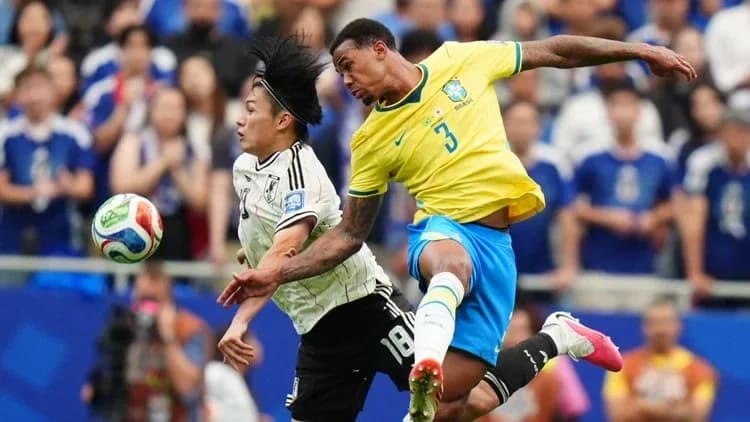
Brazil Survives at the Last Minute: Japan Fought Hard, Martinelli Finished It Off
Brazil advanced to the Round of 16 with a 90th-minute goal from Martinelli, despite falling behind against Japan, with 19 shots and 1.92 xG.
Brazil Survived Late: Japan Resisted, Martinelli Sent the Seleção Through
Brazil are through to the Round of 16 after a dramatic 2-1 victory over Japan in the FIFA World Cup Round of 32.
The scoreline looks straightforward.
The favorites won.
Brazil move on.
But the match was far more complicated than that.
Japan took the lead in the 29th minute through Kaishu Sano and spent long periods defending their advantage.
Brazil dominated possession, territory and chances, yet needed a late goal from Gabriel Martinelli in the 90th minute to avoid extra time.
This was not a comfortable knockout victory.
It was a test of patience.
And eventually, a demonstration of Brazil's quality and persistence.
Brazil Controlled the Match, Japan Controlled the Scoreboard
From the opening whistle, Brazil took command of possession.
They finished the match with:
69% possession
682 passes
92% pass accuracy
19 shots
7 shots on target
1.92 xG
17 key passes
4 big chances
Japan's numbers were very different:
31% possession
315 passes
5 shots
2 shots on target
0.26 xG
3 key passes
0 big chances
The statistics tell a clear story.
Brazil had the ball.
Brazil dictated the tempo.
Brazil played in Japan's half.
But Japan scored first.
Sano's goal carried an xG value of just 0.05, meaning Brazil conceded from one of Japan's few meaningful moments.
For a favorite in a knockout game, this is the most dangerous scenario possible.
You dominate the match.
The opponent scores with one opportunity.
Suddenly, the game becomes a test of patience.
Brazil passed that test.
Japan's Defensive Plan Worked for a Long Time
Japan lined up in a 3-4-2-1 formation that often became a 5-4-1 without the ball.
The objective was clear:
Protect the central areas.
Slow Brazil's passing rhythm.
Crowd Vinicius Junior and Rayan in wide areas.
Isolate Matheus Cunha in the penalty area.
Counter quickly whenever possession was recovered.
For more than an hour, the plan worked.
Japan defended with discipline and commitment.
Their numbers underline that effort:
45 clearances
6 blocked shots
4 saves by Zion Suzuki
Brazil created pressure but struggled to break the defensive structure consistently.
The problem for Japan was on the other side of the ball.
Five shots and only 0.26 xG are rarely enough to eliminate Brazil.
They found the opening goal.
They never found a second threat.
Brazil's Pressure Never Stopped
The most impressive aspect of Brazil's performance was their response after conceding.
They never lost control.
They never became desperate.
Instead, they continued to increase the pressure.
The period between the 46th and 60th minutes was particularly dominant.
Brazil produced:
6 shots
1.11 xG
Japan did not attempt a single shot during that spell.
The equalizer felt inevitable.
Eventually, it arrived through Casimiro.
Casimiro's Goal Changed Everything
Casimiro's header in the 56th minute was more than an equalizer.
It completely shifted the momentum of the match.
The midfielder finished with:
2 shots
0.72 xG
1 goal
91 touches
76 passes
89% pass accuracy
His performance highlighted one of Brazil's biggest strengths.
Their goals do not have to come exclusively from the front line.
Their midfielders attack the box.
Their set pieces create danger.
Their second-wave runs are difficult to track.
Casimiro's goal was a perfect example of that.
Martinelli Changed the Match
Gabriel Martinelli entered the game in the 66th minute.
Twenty-four minutes later, he became the hero.
The Arsenal forward produced:
2 shots
0.26 xG
0.80 xGoT
The winning goal in the 90th minute
His introduction changed the dynamic of Brazil's attack.
Vinicius Junior had spent most of the evening facing multiple defenders.
Martinelli attacked the spaces more directly.
His movement was more aggressive.
His decision-making was quicker.
Eventually, that difference decided the match.
Knockout football often comes down to squad depth.
Brazil's bench made the difference.
Bruno Guimarães Was the Game's Real Conductor
The goals belonged to Casimiro and Martinelli.
The game itself belonged to Bruno Guimarães.
The Newcastle midfielder finished with the highest rating on the pitch at 7.97.
His numbers:
69 touches
49 passes
92% pass accuracy
4 shots
4 key passes
0.20 xG
Bruno wasn't simply circulating possession.
He was constantly involved in the final phase of attacks.
He created chances.
He threatened the goal himself.
He controlled the rhythm of the match.
Against a compact defensive block, his ability to connect every phase of Brazil's attack proved invaluable.
Why Japan Could Not Hold On
Japan defended bravely.
Eventually, they ran out of solutions.
Two statistics explain why.
First, they struggled to keep possession.
Brazil recovered the ball every 19 seconds on average.
Japan needed 53 seconds.
That difference is enormous.
Japan never had enough time to rest or build sustained attacks.
Second, they simply did not create enough danger.
Their total xG was just 0.26.
Their box xG was only 0.09.
They created zero big chances.
Against a team with Brazil's attacking talent, defending for 90 minutes without posing a significant threat is an almost impossible task.
A Warning Sign for Brazil
Brazil advanced and deserved to advance.
But the performance was not perfect.
They still looked uncomfortable against a deep defensive block for long periods.
Seven of their nineteen shots came from outside the penalty area.
At times they became impatient and relied on low-percentage attempts.
Against stronger opponents, those moments could become costly.
Brazil conceded from Japan's first meaningful attack.
Future opponents may punish them more severely.
Still, the positives outweigh the concerns.
Brazil remained calm after falling behind.
They continued to create chances.
They trusted their structure.
Eventually, quality prevailed.
Ancelotti's Biggest Win Was His Squad Depth
Carlo Ancelotti's substitutions changed the game.
Martinelli scored the winner.
Endrick provided fresh energy and produced 0.20 xG in his appearance.
Fabinho helped stabilize the midfield late in the game.
Brazil's depth could become their greatest advantage in the knockout rounds.
Not every match will go according to plan.
Against Japan, the bench delivered the solution.
That could prove decisive later in the tournament.
Final Thoughts
Brazil survived.
But they also learned something about themselves.
They showed resilience.
They showed patience.
They showed the ability to recover from adversity.
At the same time, they exposed some vulnerabilities against organized defensive blocks.
The quality difference eventually appeared in the 90th minute.
The next opponent may not give them that much time.
Still, this was the kind of victory championship teams often need.
Not a perfect performance.
Not an easy night.
Just enough quality, at exactly the right moment.