Süper Lig After Six Weeks: Who Actually Had the Toughest Start?
The table shows who collected the points, but not how hard their route was. StatsLook’s Fixture Difficulty Index adds preseason opponent strength to the picture — and changes how Galatasaray, Amed SK, Kocaelispor, Fenerbahçe and Beşiktaş should be judged after six weeks.

Six weeks into the Süper Lig season, Galatasaray and Amed SK sit on 13 points, with Beşiktaş and Kocaelispor one point behind. The standings tell us who has taken the points. They do not tell us how difficult those points were to earn.
That distinction matters over a sample this small. Twelve points collected against several of the league’s stronger sides should not necessarily be treated the same as twelve points accumulated through a more favourable opening schedule.
StatsLook therefore assessed the first six matchweeks through a second lens: the preseason strength of every opponent faced. We then compared that schedule difficulty with actual points and expected-goal (xG) performance.
The result is a rather different picture of the opening weeks.
How the StatsLook Fixture Difficulty Index works
The model begins with 2025/26 performance.
Preseason team strength is built from two components: xG difference (xGD) and points performance. xGD carries a 65% weight, while points account for the remaining 35%.
Rather than reducing teams to a simple league rank, both variables are standardised and combined into a continuous strength score. That matters because the gap between first and second is not necessarily the same as the gap between ninth and tenth. A ranking system that treats every position as one equal step would erase those differences.
For promoted sides Amed SK, Erzurumspor and Çorum FK, their relative performance in the 1. Lig is retained, but their strength is calibrated into the lower end of the Süper Lig distribution. This avoids treating raw numbers produced in two different competitions as directly equivalent.
The average strength of each team’s first six opponents is then calculated.
There is one further adjustment. Galatasaray cannot play Galatasaray. Beşiktaş cannot play Beşiktaş. Every club therefore has a slightly different theoretical opponent pool. To remove that structural bias, each team’s actual six-opponent average is compared with the average strength of the 17 opponents it could have faced.
The index is centred on 100.
A number above 100 means a club faced a harder-than-average schedule relative to its own possible opponent pool. A number below 100 indicates a more favourable opening.
The index is not a percentage. A rating of 120 does not mean a schedule was “20% harder”; it represents a large positive deviation from the league’s neutral baseline.
Gençlerbirliği had the toughest opening schedule
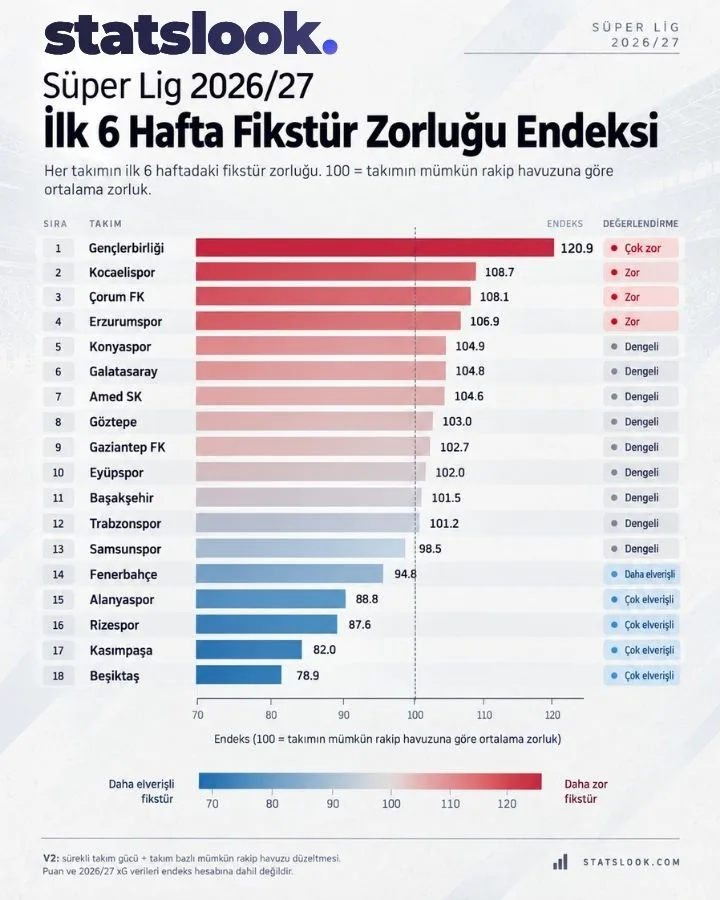
At the top of the index is Gençlerbirliği at 120.9.
Their first six opponents were Fenerbahçe, Göztepe, Erzurumspor, Trabzonspor, Kasımpaşa and Başakşehir. Relative to the teams Gençlerbirliği could have faced, no club was handed a tougher opening run.
They collected seven points from those six matches, but their underlying performance was much less encouraging: -6.9 xGD.
That does not make seven points a poor return. It does, however, show how strongly the schedule weighed on their opening performance.
Behind them come Kocaelispor at 108.7, Çorum FK at 108.1 and Erzurumspor at 106.9.
Their point totals need to be read with that context attached.
Kocaelispor’s 12 points are impressive — but the -4.7 xGD matters
Few teams have a more interesting first-six-weeks profile than Kocaelispor.
Their 108.7 Fixture Difficulty Index ranks as the second-hardest opening schedule in the league, yet they still collected 12 points.
From a results perspective, that is an excellent return.
The underlying numbers are far less comfortable.
Kocaelispor posted an xGD of -4.7, meaning opponents generated substantially better chances over the same period.
That makes them one of the clearest result-versus-process outliers in the league.
The point is not to dismiss those 12 points. If anything, their value increases when the difficulty of the opposition is considered. But a negative xG differential of this size raises an obvious question about how sustainable that points rate will be if the balance of chances remains unchanged.
Galatasaray’s 13 points are backed up by both schedule and performance
Galatasaray also finished six weeks on 13 points.
Their Fixture Difficulty Index stands at 104.8, meaning their opening run was moderately tougher than the neutral baseline for their own potential opponent pool.
They also produced a +7.1 xGD.
That combination matters.
The 13-point return is not simply strong in the standings. It is supported by the quality of Galatasaray’s underlying performance and was achieved against an above-average schedule.
Başakşehir, Göztepe, Kocaelispor and Trabzonspor all appeared in their first six fixtures. There is little evidence here that Galatasaray’s position was inflated by an unusually soft opening calendar.
So far, the results and the process broadly agree.
Amed SK are more than an early-season surprise
Amed SK are level with Galatasaray on 13 points.
Their Fixture Difficulty Index is 104.6, while their xGD stands at +4.6.
For a newly promoted side, that combination deserves more attention than the label of “surprise leaders” might suggest.
Amed did not simply collect points. They also produced a positive chance-quality differential against an opening schedule that was slightly tougher than average.
Their first six opponents were Erzurumspor, Kocaelispor, Trabzonspor, Kasımpaşa, Başakşehir and Beşiktaş.
Taking 13 points from that run while remaining comfortably positive on xGD suggests there is more substance behind the start than pure finishing variance.
Galatasaray’s +7.1 xGD points to the stronger underlying performance of the two, but Amed’s +4.6 still provides meaningful support for their position in the table.
Fenerbahçe’s performances are ahead of their points
Fenerbahçe stand out in the opposite direction.
Their Fixture Difficulty Index is 94.8, placing their opening schedule slightly on the favourable side of average.
They took 10 points.
Yet their underlying performance was outstanding: +9.1 xGD, the strongest figure in the league over the opening six rounds.
That is a significant gap between process and return.
Fenerbahçe have produced and conceded chances at a level that suggests a much stronger performance than their points total currently reflects.
Given both the relatively favourable schedule and the +9.1 xGD, ten points look modest.
The central question is therefore not whether Fenerbahçe have played well enough. It is why such a large underlying advantage has not been converted into more points.
Beşiktaş made good use of a favourable schedule
At the other end of the scale sit Beşiktaş.
Their 78.9 index represents the most favourable opening schedule in the league.
They collected 12 points and produced a +7.3 xGD.
That does not support the simplistic conclusion that Beşiktaş accumulated points only because of an easy fixture list.
The schedule was favourable. The performance was also good.
A +7.3 xGD shows that Beşiktaş did more than take advantage of weaker opposition through results alone; they also controlled the quality of chances over the opening six games.
The better interpretation is straightforward:
Beşiktaş used a favourable schedule well.
The next question is whether that level of performance holds as the quality of opposition rises.
Kasımpaşa at 82.0, Rizespor at 87.6 and Alanyaspor at 88.8 also sit on the more favourable side of the fixture spectrum. Kasımpaşa and Rizespor collected ten points, while Alanyaspor took eleven.
Same points, very different starts
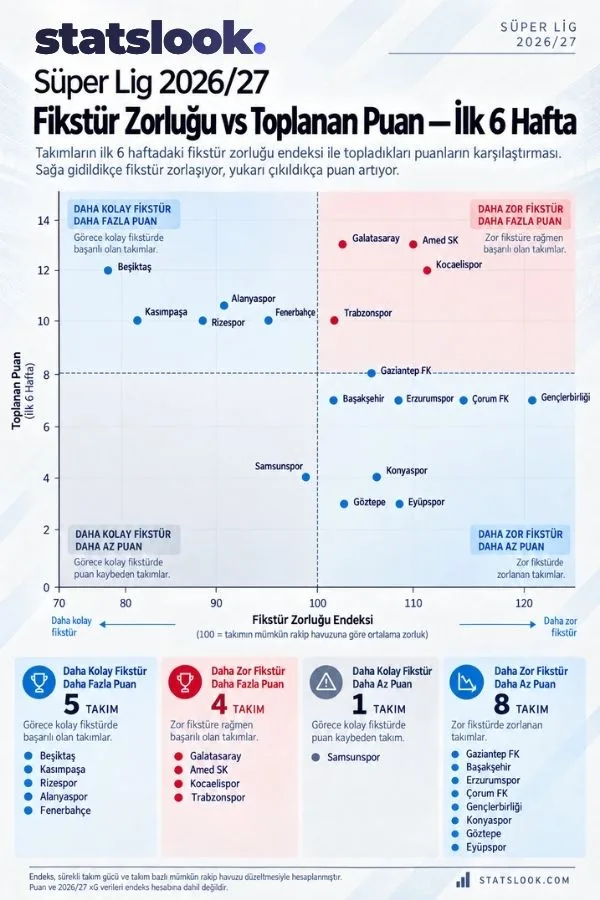
Putting fixture difficulty and points on the same chart produces four distinct groups.
Galatasaray, Amed SK, Kocaelispor and Trabzonspor combined above-average schedule difficulty with above-average points returns.
Beşiktaş, Alanyaspor, Kasımpaşa, Rizespor and Fenerbahçe collected strong returns from the more favourable half of the schedule distribution.
Samsunspor had a more favourable opening but managed only four points.
Gençlerbirliği, Çorum FK, Erzurumspor, Başakşehir, Gaziantep FK, Konyaspor, Göztepe and Eyüpspor faced above-average schedule difficulty while remaining in the lower points group.
The purpose is not to label one group “good” and another “bad”. It is to understand the context in which the points were produced.
What the table alone cannot show
After six rounds, Galatasaray and Amed SK have the same points total. Beşiktaş and Kocaelispor are both one point behind.
But those four starts are not equivalent.
Galatasaray combined an above-average schedule with +7.1 xGD. Amed reached the same points total with +4.6 xGD and a similarly challenging schedule.
Kocaelispor extracted 12 points from one of the hardest schedules in the league, but -4.7 xGD suggests results have run well ahead of the underlying process.
Beşiktaş had one of the easiest openings, but their +7.3 xGD shows they made genuine use of that advantage.
Fenerbahçe tell another story again: a slightly favourable schedule, only ten points, but a league-best +9.1 xGD.
The league table tells us what happened.
Fixture difficulty and expected-goal data start to explain how it happened.
StatsLook Fixture Difficulty Index — First Six Weeks
Data note
The StatsLook Fixture Difficulty Index uses team strength measured before the start of the season.
Preseason strength combines the previous season’s xG difference and points performance, weighted 65% toward xGD and 35% toward points. The variables are standardised before being combined into a continuous strength score.
For each club, the average strength of its first six opponents is then compared with the average strength of the other 17 teams it was theoretically able to face. This removes the structural distortion created by the fact that a team cannot play itself.
The index is centred on 100. Values above 100 indicate a tougher-than-average opening schedule; values below 100 indicate a more favourable one.
Points, goals and xG produced during the 2026/27 season are not used to calculate fixture difficulty. They are introduced only after the index has been calculated, in order to evaluate performance.
Home and away effects are not included in the current model.
Frequently Asked Questions
Which Süper Lig team had the toughest schedule over the first six weeks?
According to the StatsLook Fixture Difficulty Index, Gençlerbirliği had the toughest opening schedule at 120.9. Kocaelispor followed at 108.7, with Çorum FK at 108.1 and Erzurumspor at 106.9.
How is the StatsLook Fixture Difficulty Index calculated?
Preseason strength is built from the previous season’s xG difference and points performance. A team’s first six opponents are then compared with the average strength of the 17 opponents that club could theoretically have faced. An index of 100 represents average fixture difficulty.
Are this season’s points or xG included in the fixture difficulty calculation?
No. 2026/27 points and xG figures do not influence the index. They are used only afterwards to compare results and underlying performance with the difficulty of each team’s schedule.